THE DIFFERENCES THAT MATTER
JBL Boombox 3 vs Sony ULT FIELD 7: speaker linking or instrument input?
Compare the original Bluetooth Boombox 3 and SRS-ULT70 around real source connections, carrying and party setup.
Researched from manufacturer sources. These products have not been hands-on tested for this article.
START HERE
Are you extending an existing compatible speaker group or bringing a microphone or guitar to the gathering?
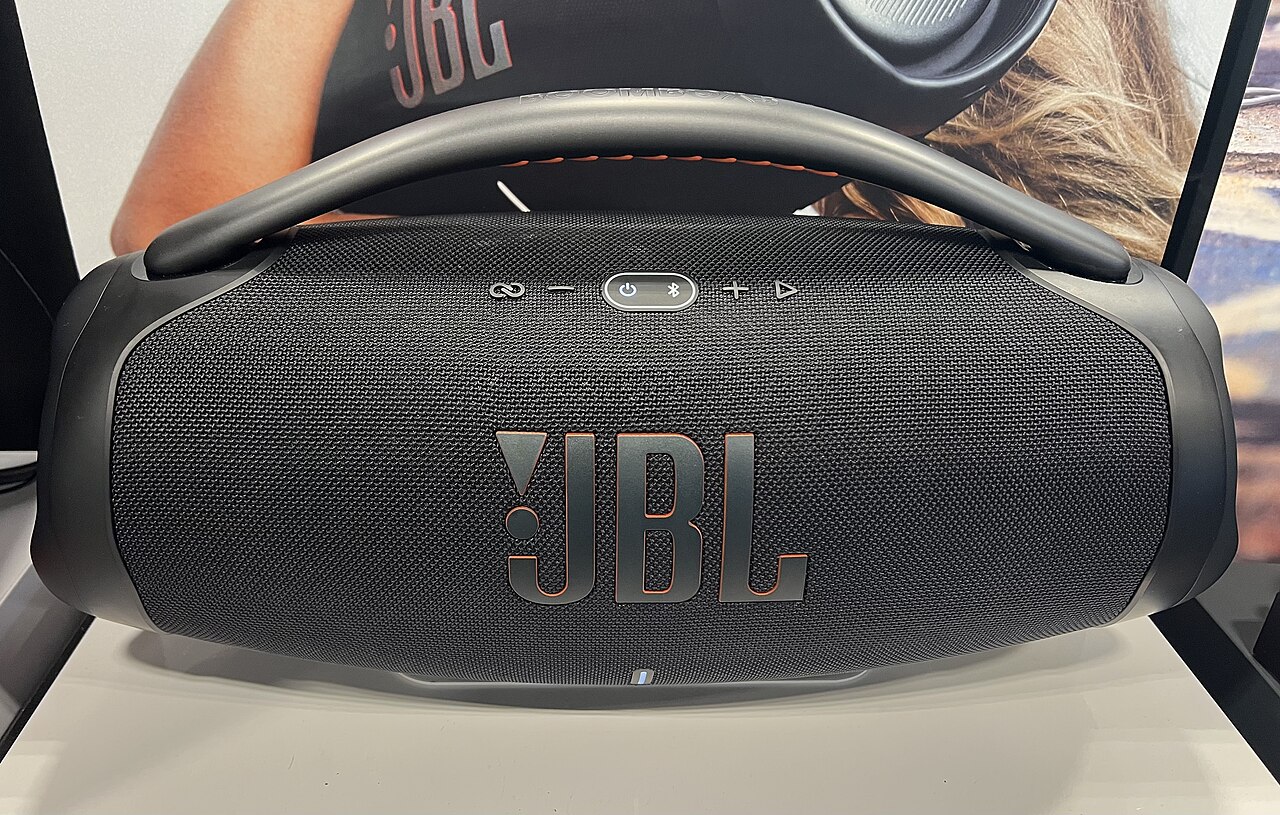
JBL Boombox 3 and Sony ULT FIELD 7 are substantial portable Bluetooth speakers. JBL lists 14.7 lb and Sony about 13.89 lb, so neither is a pocket travel speaker. The more useful distinction can be the equipment attached: JBL uses PartyBoost for supported speaker linking, while Sony includes a microphone/guitar input and its own Party Connect system. This comparison is the original non-Wi-Fi Boombox 3 and Sony SRS-ULT70.
JBL Boombox 3 (original Bluetooth model; black)
A good fit if: A shortlist option when PartyBoost compatibility, a carry handle and an auxiliary source define the use.
The tradeoff: This is not Boombox 3 Wi-Fi. Linking protocols must match, and the substantial weight needs a carrying plan.
Sony ULT FIELD 7 (SRS-ULT70; black)
A good fit if: A shortlist option when a microphone or guitar input belongs in the same portable speaker.
The tradeoff: The 30-hour maximum depends on the specified settings; lights and operating modes change battery use.
As an Amazon Associate I earn from qualifying purchases. How shopping links work.
JBL Boombox 3
View this model on Amazon : JBL Boombox 3 (original Bluetooth model; black) (opens in a new tab)Original Bluetooth Boombox 3; not Boombox 3 Wi-Fi.Sony ULT FIELD 7
View this model on Amazon : Sony ULT FIELD 7 (SRS-ULT70; black) (opens in a new tab)Check the seller, exact variant, price and included accessories.See the product photos and comparison illustration
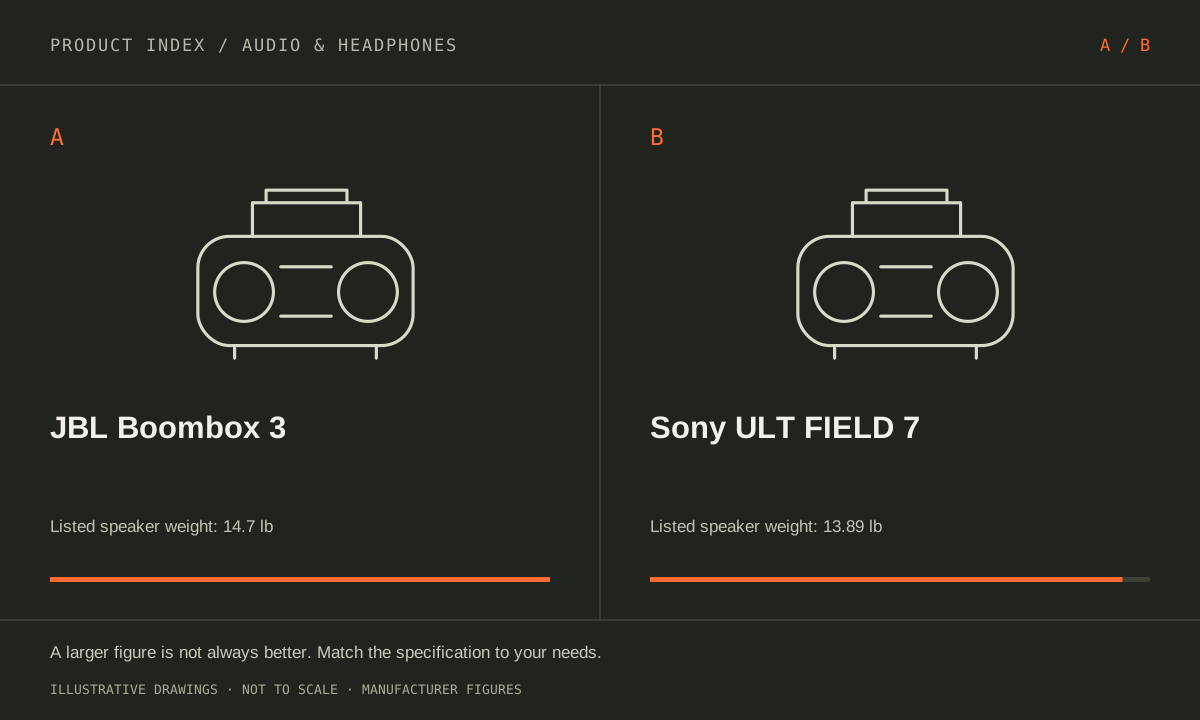
The facts, side by side.
Manufacturer specifications for the named models. On small screens, scroll the table sideways. A blank research field means the fact was not included here, not that the manufacturer does not publish it. Conditions and differently scoped specifications are kept separate.
| What matters | JBL Boombox 3 [1] | Sony ULT FIELD 7 [2] |
|---|---|---|
| Type | Large portable Bluetooth speaker; original non-Wi-Fi model | Large portable Bluetooth party speaker |
| Listed weight | 14.7 lb / 6.7 kg | Approximately 13.89 lb / 6.3 kg |
| Battery claim | Up to 24 hours; volume and content affect results | Up to 30 hours under Sony specified settings |
| Water/dust rating | IP67 in JBL specification | IP67 with covers correctly closed; conditions apply |
| Inputs | Bluetooth 5.3 and 3.5 mm auxiliary input | Bluetooth, stereo mini, USB-A and microphone/guitar input |
| Speaker linking | JBL PartyBoost-compatible products | Sony Party Connect; supported stereo pairing |
| Charging role | USB power bank output | Not included in this comparison |
| Bluetooth codecs | Not included in this comparison | SBC, AAC and LDAC |
Listed maximums are manufacturer claims under their stated conditions, not results from our own testing. Regional versions and bundles can differ. No live prices or stock claims are shown.
List the music source and anything else plugged in
Both support Bluetooth and an auxiliary stereo input. Sony additionally lists USB-A and a microphone/guitar input. If announcements, singing or a guitar are part of the occasion, verify the required cable, input mode and level controls in Sony’s guide before buying. A microphone socket is a concrete workflow difference; it does not turn the speaker into a complete public-address or recording system for every venue and instrument.
For straightforward playback from a phone, the extra inputs may not solve a problem. Identify whether you need a wired source, charging for the phone, or operation away from mobile data. A phone connected by Bluetooth can still need downloaded music or an available internet connection. Check the physical connector and intended charging role instead of assuming every USB port accepts the same storage, audio and power tasks. Pack the relevant cables as part of the speaker kit.
Manufacturer references: JBL Boombox 3 · Sony ULT FIELD 7
A speaker-linking logo is a compatibility boundary
JBL specifies PartyBoost on the original Boombox 3. Sony specifies Party Connect and supported stereo pairing for ULT FIELD 7. These are manufacturer-specific systems, so a JBL speaker and Sony speaker should not be purchased as a presumed synchronized pair. If you already own another speaker, check its exact model and supported linking generation. Similar appearance or a shared Bluetooth label does not establish the required group behavior.
Also distinguish a party group from a supported left/right stereo pair. Confirm how many compatible speakers, which app and which connection modes work together for the intended arrangement. Placement matters: speakers distributed across a gathering face different needs from two units beside a desk. A broad linking claim cannot establish synchronization performance throughout an unknown venue. Plan the actual positions and power needs instead of buying additional units solely because a large maximum group count appears in marketing.
Manufacturer references: JBL Boombox 3 · Sony ULT FIELD 7
Battery claims and weather protection need their conditions
JBL advertises up to 24 hours and Sony up to 30 hours under their specified conditions. They are not results from one shared listening level, lighting setting or test track, so this is not evidence of a six-hour real-world advantage. For an event, leave margin and identify safe charging access. Lighting, enabled sound modes, volume and content can alter power use. A long maximum cannot guarantee the length of a particular outdoor gathering.
Both manufacturers specify IP67 with conditions, including correct cover handling; the selected JBL retailer title uses different IPX7 wording, flagged in the product note. Follow the manufacturer’s exposure and charging instructions. Check the carry route and destination surface with roughly fourteen pounds of equipment. Favor JBL for an exact existing PartyBoost arrangement or its source package. Favor Sony when the documented microphone/guitar or USB workflow is needed. Sound level, bass quality and endurance require suitable comparative measurements before ranking either overall.
Manufacturer references: JBL Boombox 3 · Sony ULT FIELD 7
A CLOSER LOOK AT OWNERSHIP
Beyond the specification sheet.
Additional model-specific document research checked October 20, 2026. The original comparison’s specification check date remains shown above.
Check the complete setup before ordering
Check that the listing is the original Bluetooth Boombox 3. JBL’s PartyBoost guide restricts stereo pairing to two of the same model and distinguishes PartyBoost from older grouping systems. List the speakers you already own by model; a shared JBL badge is not sufficient evidence that the planned group will work.
For ULT FIELD 7, write down whether the job is Bluetooth music, a microphone, or an instrument connection. Check the exact input and control requirements against the SRS-ULT70 documentation. Rehearse the intended source and placement; the presence of an input is not a guarantee of satisfying feedback control or stage performance.
Sources: JBL Boombox 3 — manufacturer model information; no independent performance test (opens in a new tab) · JBL PartyBoost — compatible grouping and same-model stereo requirement (opens in a new tab) · Sony ULT FIELD 7 — manufacturer model information; no independent performance test (opens in a new tab)
Price the equipment you will actually use
Price Boombox 3 with any second speaker you genuinely intend to use, then compare that total with a single-speaker setup. Account for its storage and carrying footprint. If the main requirement is stationary household music, consider whether you need to pay for a large portable battery in the first place.
Include any compatible microphone, instrument cable, and carrying arrangement in the ULT FIELD 7 quote. Buy those accessories only for a real use case. If lighting and high-output modes are part of the attraction, evaluate the complete operating routine rather than planning battery endurance from a single headline figure.
Sources: JBL Boombox 3 — manufacturer model information; no independent performance test (opens in a new tab) · JBL PartyBoost — compatible grouping and same-model stereo requirement (opens in a new tab) · Sony ULT FIELD 7 — manufacturer model information; no independent performance test (opens in a new tab)
Plan care, parts, and the service route
Request the exact Boombox 3 care instructions and current battery-service route from JBL. Confirm port-cover and charging precautions for the intended setting instead of interpreting a protection rating as permission for every exposure. Ask whether the seller handles a fault locally or requires shipping the complete speaker.
Ask Sony for the SRS-ULT70 care procedure and service options, including internal-battery work and connector faults. The specification page does not establish a particular repair cost or all moisture-use conditions. Confirm those before using the speaker around water or purchasing it as an essential event sound system.
Sources: JBL Boombox 3 — manufacturer model information; no independent performance test (opens in a new tab) · JBL PartyBoost — compatible grouping and same-model stereo requirement (opens in a new tab) · Sony ULT FIELD 7 — manufacturer model information; no independent performance test (opens in a new tab)
What rules each option out—and when to keep what you own
The useful distinction may be the connection job rather than battery or bass claims. If a microphone or instrument is essential, verify Sony’s exact input requirements. If expansion with existing JBL speakers is essential, check PartyBoost compatibility and stereo rules. Reject either plan when it depends on cross-brand or cross-generation grouping that has not been documented.
Keep an existing portable speaker if it covers the gathering and connects reliably. For stationary parties or performances, compare a suitable powered-speaker system before assuming a battery boombox is the best category. Rehearse carrying, setup, controls, and the intended source; a high-volume marketing position is not evidence of the sound level or clarity your event needs.
Sources: JBL Boombox 3 — manufacturer model information; no independent performance test (opens in a new tab) · JBL PartyBoost — compatible grouping and same-model stereo requirement (opens in a new tab) · Sony ULT FIELD 7 — manufacturer model information; no independent performance test (opens in a new tab)
THE REST OF THE BUYING DECISION
Think beyond the upgrade.
Audio equipment earns its place by being comfortable, easy to connect, and useful in the room or routine you actually have. Start with your listening source and the problem you want to solve. A codec badge, driver count, or spatial-audio logo cannot establish the best sound for every listener. The guidance here combines official setup documentation with an explicit checklist for your own evaluation.
The audio & headphones field guide covers the broader ownership questions, with source-specific examples. It complements this exact-model comparison; its examples do not establish features or policies for every model here.
MAKE IT YOUR DECISION
Your before-you-buy checklist.
Use this as a final check, alongside the model-specific evidence above.
Check off the questions you have resolved. Nothing is sent to a server.
Before you place the order.
- Match the full model name and generation. A similarly named bundle may have different accessories.
- Confirm the total price, seller, warranty eligibility, delivery estimate, and return terms at checkout.
- Account for any accessories or compatible equipment your setup needs. An upgrade only has value if you will use it.
Your product questions, answered.
Can Boombox 3 and ULT FIELD 7 be linked as a synchronized manufacturer group?
Do not assume that. PartyBoost and Party Connect are separate compatibility systems; check exact supported models.
Is this JBL Boombox 3 Wi-Fi?
No. The linked product is the original Bluetooth Boombox 3. Wi-Fi-model features and package details do not apply.
Can any JBL speaker form a stereo pair with Boombox 3?
No. JBL’s PartyBoost guide requires matching models for stereo and distinguishes older grouping systems. Verify the exact speakers already owned before purchasing a second unit.
Sources: JBL Boombox 3 — manufacturer model information; no independent performance test (opens in a new tab) · JBL PartyBoost — compatible grouping and same-model stereo requirement (opens in a new tab) · Sony ULT FIELD 7 — manufacturer model information; no independent performance test (opens in a new tab)
Does Sony’s input guarantee a complete karaoke setup?
No. Verify microphone or instrument compatibility, cables, controls, and the intended placement. Rehearse the actual setup rather than treating an input socket as proof of event suitability.
Sources: JBL Boombox 3 — manufacturer model information; no independent performance test (opens in a new tab) · JBL PartyBoost — compatible grouping and same-model stereo requirement (opens in a new tab) · Sony ULT FIELD 7 — manufacturer model information; no independent performance test (opens in a new tab)
Which battery-life figure should I use?
Use the conditions matching your intended modes and volume, with reserve. Published maxima do not establish endurance for a loud event with additional features enabled.
Sources: JBL Boombox 3 — manufacturer model information; no independent performance test (opens in a new tab) · JBL PartyBoost — compatible grouping and same-model stereo requirement (opens in a new tab) · Sony ULT FIELD 7 — manufacturer model information; no independent performance test (opens in a new tab)
What damage coverage should I ask about?
Ask separately about battery deterioration, connectors, moisture exposure, and accidental damage. A protection rating and a manufacturer warranty answer different questions and require exact-model terms.
Sources: JBL Boombox 3 — manufacturer model information; no independent performance test (opens in a new tab) · JBL PartyBoost — compatible grouping and same-model stereo requirement (opens in a new tab) · Sony ULT FIELD 7 — manufacturer model information; no independent performance test (opens in a new tab)
Sources & limitations.
Original comparison research: October 18, 2026. Individual product-source checks and ownership additions carry their own dates. These links identify the manufacturer evidence used for the specifications. Recommendations and practical implications are our editorial judgments. We have not measured performance, reliability, comfort, or long-term ownership for this comparison.
- JBL Boombox 3 (original Bluetooth model; black) — manufacturer specifications (opens in a new tab)
The exact Amazon listing title uses IPX7 wording; JBL’s original Boombox 3 specification states IP67. The manufacturer rating is used here.
Checked October 18, 2026. - Sony ULT FIELD 7 (SRS-ULT70; black) — manufacturer specifications (opens in a new tab)
Sony ULT FIELD 7 US product details (opens in a new tab)
Checked October 18, 2026.
Confirm current specifications for your region and exact bundle. Read our research and correction approach.