THE DIFFERENCES THAT MATTER
Apple AirPods Max USB-C vs Bose QC Ultra 2nd Gen: switching or weight?
Compare exact generations around supported Apple features, wired USB listening, weight and battery conditions.
Researched from manufacturer sources. These products have not been hands-on tested for this article.
START HERE
Will supported Apple switching be used every day, or does the lighter headset and longer published battery allowance matter more?
The 2024 USB-C AirPods Max 1 and Bose QuietComfort Ultra Headphones 2nd Gen both provide active noise cancellation and supported wired digital listening. Their practical fit depends on the devices around them. Apple emphasizes features across supported Apple hardware; Bose is substantially lighter in the published specifications. This comparison keeps those exact generations separate from Lightning AirPods Max, later AirPods generations and first-generation QC Ultra.
Apple AirPods Max 1 (USB-C; 2024)
A good fit if: A shortlist option when supported Apple device switching and Spatial Audio are part of the daily listening routine.
The tradeoff: The original USB-C model has a shorter published ANC battery claim and higher listed weight than the original Px8.
Bose QuietComfort Ultra Headphones (2nd Gen)
A good fit if: A shortlist option when USB-C digital listening or the Bose Immersive Audio modes suit your routine.
The tradeoff: Bose’s page contains inconsistent battery footnotes; its headline claim is not a verified comparative endurance result.
As an Amazon Associate I earn from qualifying purchases. How shopping links work.
AirPods Max USB-C
View this model on Amazon : Apple AirPods Max 1 (USB-C; 2024) (opens in a new tab)Check the seller, exact variant, price and included accessories.QC Ultra (2nd Gen)
View this model on Amazon : Bose QuietComfort Ultra Headphones (2nd Gen) (opens in a new tab)Check the seller, exact variant, price and included accessories.See the product photos and comparison illustration
The facts, side by side.
Manufacturer specifications for the named models. On small screens, scroll the table sideways. A blank research field means the fact was not included here, not that the manufacturer does not publish it. Conditions and differently scoped specifications are kept separate.
| What matters | AirPods Max USB-C [1] | QC Ultra (2nd Gen) [2] |
|---|---|---|
| Style | Over-ear; active noise cancellation | Around-ear, active noise cancelling |
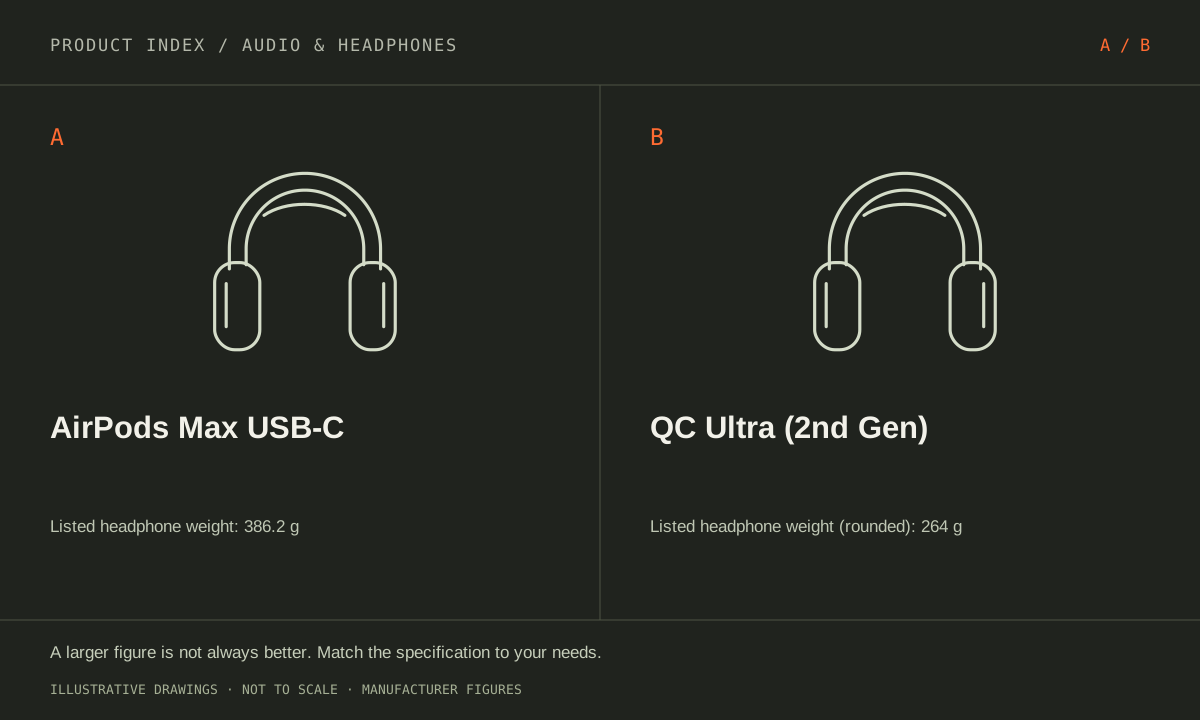
| Listed headphone weight | 386.2 g including cushions (current US support page) | 0.583 lb (about 264 g) |
| Music battery claim | Up to 20 hours with ANC enabled | Headline: up to 30 hours; 23 with Immersive Audio |
| Wired listening | USB-C lossless audio; compatible software/device required | Not included in this comparison |
| Bluetooth version | 5.0 | 5.4 |
| Platform features | Personalized Spatial Audio and automatic switching on supported Apple devices | Not included in this comparison |
| Full charge claim | Not included in this comparison | Approximately 3 hours |
| Connection detail | Not included in this comparison | USB-C digital audio; included 3.5-to-2.5 mm audio cable |
Listed maximums are manufacturer claims under their stated conditions, not results from our own testing. Regional versions and bundles can differ. No live prices or stock claims are shown.
Write down the devices you switch between
For an Apple household, supported automatic switching and Personalized Spatial Audio can be useful when the same headphones move among compatible devices. Check current software and account requirements for the actual phone, tablet, computer and television. Feature availability on supported Apple devices does not mean the same experience appears on every Bluetooth source. If the main listening device is elsewhere, evaluate the connection you will actually use rather than the fullest feature list advertised for another platform.
Bose offers its own supported connection and control arrangements across compatible sources. Check the current manual for pairing, simultaneous connections and call handling with your specific work and personal devices. A pair of headphones can support a codec or connection protocol without every computer or phone exposing it. Decide whether the daily task is quick switching, calls, a wired desk connection or a single mobile device, then confirm that complete task instead of counting isolated feature names.
Manufacturer references: AirPods Max USB-C · QC Ultra (2nd Gen)
USB-C is a connector, so confirm the audio mode
AirPods Max USB-C supports lossless wired audio with compatible firmware, software and source hardware. Bose’s second-generation QC Ultra supports USB digital audio at its specified formats. Neither statement means every USB-C cable, charging port or adapter supplies the desired audio signal. Check the intended source and cable, whether a connection is providing data or only power, and which controls or features remain available in the selected wired mode.
Bose also lists a 2.5 mm-to-3.5 mm analog arrangement. Do not transfer the older Lightning AirPods Max cable workflow to the 2024 USB-C model. If aircraft entertainment, an older controller or an analog desk output matters, identify the exact supported route and accessories before purchasing. A digital format label does not rank the resulting listening experience without appropriate evidence, and a cable that fits one end can still be the wrong connection for the task.
Manufacturer references: AirPods Max USB-C · QC Ultra (2nd Gen)
Use weight and battery specifications as planning inputs
Apple’s current US support page lists 386.2 g including cushions for this USB-C model, while Bose lists 264 g. That is a meaningful difference to investigate for packing and a long wearing day, but it cannot establish comfort, pressure or pad fit for your head. Try the adjustment range and intended session length where possible. Also consider how the headphones, case and cables fit the actual bag rather than judging portability from the headphones alone.
Apple advertises up to twenty hours with noise cancellation enabled. Bose’s second-generation headline claim is up to thirty hours, reduced to up to twenty-three with Immersive Audio. These are manufacturer conditions, not one controlled comparison, and older Bose footnotes can cause confusion. Favor Apple when its supported integration repeatedly solves a switching task and fit is suitable. Favor Bose when its lower listed mass, documented connection options or battery allowance fits the routine. Neither specification justifies an unmeasured ANC or sound winner.
Manufacturer references: AirPods Max USB-C · QC Ultra (2nd Gen)
A CLOSER LOOK AT OWNERSHIP
Beyond the specification sheet.
Additional model-specific document research checked October 20, 2026. The original comparison’s specification check date remains shown above.
Check the complete setup before ordering
Confirm the 2024 USB-C AirPods Max rather than the Lightning version. Apple’s firmware notes make wired lossless and low-latency operation dependent on supported firmware and source software. Check your actual iPhone, iPad, or Mac versions before making that feature the reason to buy.
QC Ultra Headphones 2nd Gen supports a USB audio path in its owner guide. Rehearse that connection with your computer and confirm microphone behavior in your application. Identify the second-generation product on the box; advice for the original Ultra or ordinary QuietComfort headphones can describe different connections.
Sources: AirPods Max USB-C — manufacturer model information; no independent performance test (opens in a new tab) · Apple AirPods firmware notes — USB-C Max lossless requirements (opens in a new tab) · QC Ultra (2nd Gen) — manufacturer model information; no independent performance test (opens in a new tab) · QC Ultra Headphones 2nd Gen owner guide — USB audio and powered operation (opens in a new tab) · Bose — replacement cushions specifically for QC Ultra Headphones 2nd Gen (opens in a new tab)
Price the equipment you will actually use
Budget the AirPods Max USB-C connection around the actual source, cable, and charging equipment. Do not assume a cable that charges is the whole listening setup for every device. Add a current cushion and battery-service quote if long ownership matters, and compare the carrying arrangement with your everyday bag.
Bose lists a cushion kit specifically for QC Ultra Headphones 2nd Gen. Include its current price and the adapters required by your sources in a complete ownership quote. A replaceable cushion does not establish that the internal battery is equally accessible; ask about the separate battery-service route.
Sources: AirPods Max USB-C — manufacturer model information; no independent performance test (opens in a new tab) · Apple AirPods firmware notes — USB-C Max lossless requirements (opens in a new tab) · QC Ultra (2nd Gen) — manufacturer model information; no independent performance test (opens in a new tab) · QC Ultra Headphones 2nd Gen owner guide — USB audio and powered operation (opens in a new tab) · Bose — replacement cushions specifically for QC Ultra Headphones 2nd Gen (opens in a new tab)
Plan care, parts, and the service route
Ask Apple or the authorized seller which service and return options apply to this USB-C generation. Optional protection and statutory or limited-warranty coverage are separate matters; request the specific terms instead of counting all damage as covered. Reproduce any connection fault with the required firmware before deciding the hardware is defective.
Read the second-generation owner guide for powered wired operation, charging, and care. Ask Bose which failures are repaired and which use an exchange process, and what is required from an authorized seller. This research verifies the documented accessory path, not an individual warranty result or future parts inventory.
Sources: AirPods Max USB-C — manufacturer model information; no independent performance test (opens in a new tab) · Apple AirPods firmware notes — USB-C Max lossless requirements (opens in a new tab) · QC Ultra (2nd Gen) — manufacturer model information; no independent performance test (opens in a new tab) · QC Ultra Headphones 2nd Gen owner guide — USB audio and powered operation (opens in a new tab) · Bose — replacement cushions specifically for QC Ultra Headphones 2nd Gen (opens in a new tab)
What rules each option out—and when to keep what you own
Both have documented USB listening paths, so check the exact source and software rather than treating USB-C as the differentiator. Apple’s supported features depend on its documented versions; Bose’s second-generation guide describes its own behavior. Rule out either when the actual mixed-device routine, microphone needs, or sustained fit fails despite an attractive feature list.
Keep a current pair if it already handles calls, travel, and charging comfortably. If platform integration is the proposed improvement, rehearse the complete switching sequence before purchase. Compare cushions, battery service, case size, and return terms alongside the new features so the decision includes what you will live with after the first week.
Sources: AirPods Max USB-C — manufacturer model information; no independent performance test (opens in a new tab) · Apple AirPods firmware notes — USB-C Max lossless requirements (opens in a new tab) · QC Ultra (2nd Gen) — manufacturer model information; no independent performance test (opens in a new tab) · QC Ultra Headphones 2nd Gen owner guide — USB audio and powered operation (opens in a new tab) · Bose — replacement cushions specifically for QC Ultra Headphones 2nd Gen (opens in a new tab)
THE REST OF THE BUYING DECISION
Think beyond the upgrade.
Audio equipment earns its place by being comfortable, easy to connect, and useful in the room or routine you actually have. Start with your listening source and the problem you want to solve. A codec badge, driver count, or spatial-audio logo cannot establish the best sound for every listener. The guidance here combines official setup documentation with an explicit checklist for your own evaluation.
The audio & headphones field guide covers the broader ownership questions, with source-specific examples. It complements this exact-model comparison; its examples do not establish features or policies for every model here.
MAKE IT YOUR DECISION
Your before-you-buy checklist.
Use this as a final check, alongside the model-specific evidence above.
Check off the questions you have resolved. Nothing is sent to a server.
Before you place the order.
- Match the full model name and generation. A similarly named bundle may have different accessories.
- Confirm the total price, seller, warranty eligibility, delivery estimate, and return terms at checkout.
- Account for any accessories or compatible equipment your setup needs. An upgrade only has value if you will use it.
Your product questions, answered.
Is this the Lightning AirPods Max?
No. It is the 2024 USB-C AirPods Max 1. Lightning-model cable assumptions do not apply.
Does Bose promise thirty hours with Immersive Audio?
No. Its second-generation headline maximum is thirty hours, with a separate up-to-twenty-three-hour claim when Immersive Audio is enabled.
Does USB-C imply identical wired behavior?
No. Check each model’s documented requirements and the exact source application. Apple has firmware and software conditions; Bose specifies its own powered USB-audio operation.
Sources: AirPods Max USB-C — manufacturer model information; no independent performance test (opens in a new tab) · Apple AirPods firmware notes — USB-C Max lossless requirements (opens in a new tab) · QC Ultra (2nd Gen) — manufacturer model information; no independent performance test (opens in a new tab) · QC Ultra Headphones 2nd Gen owner guide — USB audio and powered operation (opens in a new tab) · Bose — replacement cushions specifically for QC Ultra Headphones 2nd Gen (opens in a new tab)
Which parts have a clear replacement path here?
Bose lists a second-generation cushion kit. Ask both manufacturers for current cushion and battery-service options; availability of one replaceable part does not establish all repair costs.
Sources: AirPods Max USB-C — manufacturer model information; no independent performance test (opens in a new tab) · Apple AirPods firmware notes — USB-C Max lossless requirements (opens in a new tab) · QC Ultra (2nd Gen) — manufacturer model information; no independent performance test (opens in a new tab) · QC Ultra Headphones 2nd Gen owner guide — USB audio and powered operation (opens in a new tab) · Bose — replacement cushions specifically for QC Ultra Headphones 2nd Gen (opens in a new tab)
What should an Apple-device owner verify?
Confirm source versions, firmware, and the feature actually used in the daily routine. Owning an Apple device alone is not a reason to assume every advertised behavior applies.
Sources: AirPods Max USB-C — manufacturer model information; no independent performance test (opens in a new tab) · Apple AirPods firmware notes — USB-C Max lossless requirements (opens in a new tab) · QC Ultra (2nd Gen) — manufacturer model information; no independent performance test (opens in a new tab) · QC Ultra Headphones 2nd Gen owner guide — USB audio and powered operation (opens in a new tab) · Bose — replacement cushions specifically for QC Ultra Headphones 2nd Gen (opens in a new tab)
How should I judge comfort?
Use glasses and the normal listening position for a sustained session, then pack the case. Listed weight and material descriptions are insufficient to predict individual fit.
Sources: AirPods Max USB-C — manufacturer model information; no independent performance test (opens in a new tab) · Apple AirPods firmware notes — USB-C Max lossless requirements (opens in a new tab) · QC Ultra (2nd Gen) — manufacturer model information; no independent performance test (opens in a new tab) · QC Ultra Headphones 2nd Gen owner guide — USB audio and powered operation (opens in a new tab) · Bose — replacement cushions specifically for QC Ultra Headphones 2nd Gen (opens in a new tab)
Sources & limitations.
Original comparison research: October 18, 2026. Individual product-source checks and ownership additions carry their own dates. These links identify the manufacturer evidence used for the specifications. Recommendations and practical implications are our editorial judgments. We have not measured performance, reliability, comfort, or long-term ownership for this comparison.
- Apple AirPods Max 1 (USB-C; 2024) — manufacturer specifications (opens in a new tab)
This is the 2024 USB-C AirPods Max 1, not the Lightning model or a later generation. The current US support page lists 386.2 g; some regional or older pages list 384.8 g.
Apple AirPods Max connections and automatic switching (opens in a new tab)
Checked October 18, 2026. - Bose QuietComfort Ultra Headphones (2nd Gen) — manufacturer specifications (opens in a new tab)
Checked October 18, 2026.
Confirm current specifications for your region and exact bundle. Read our research and correction approach.