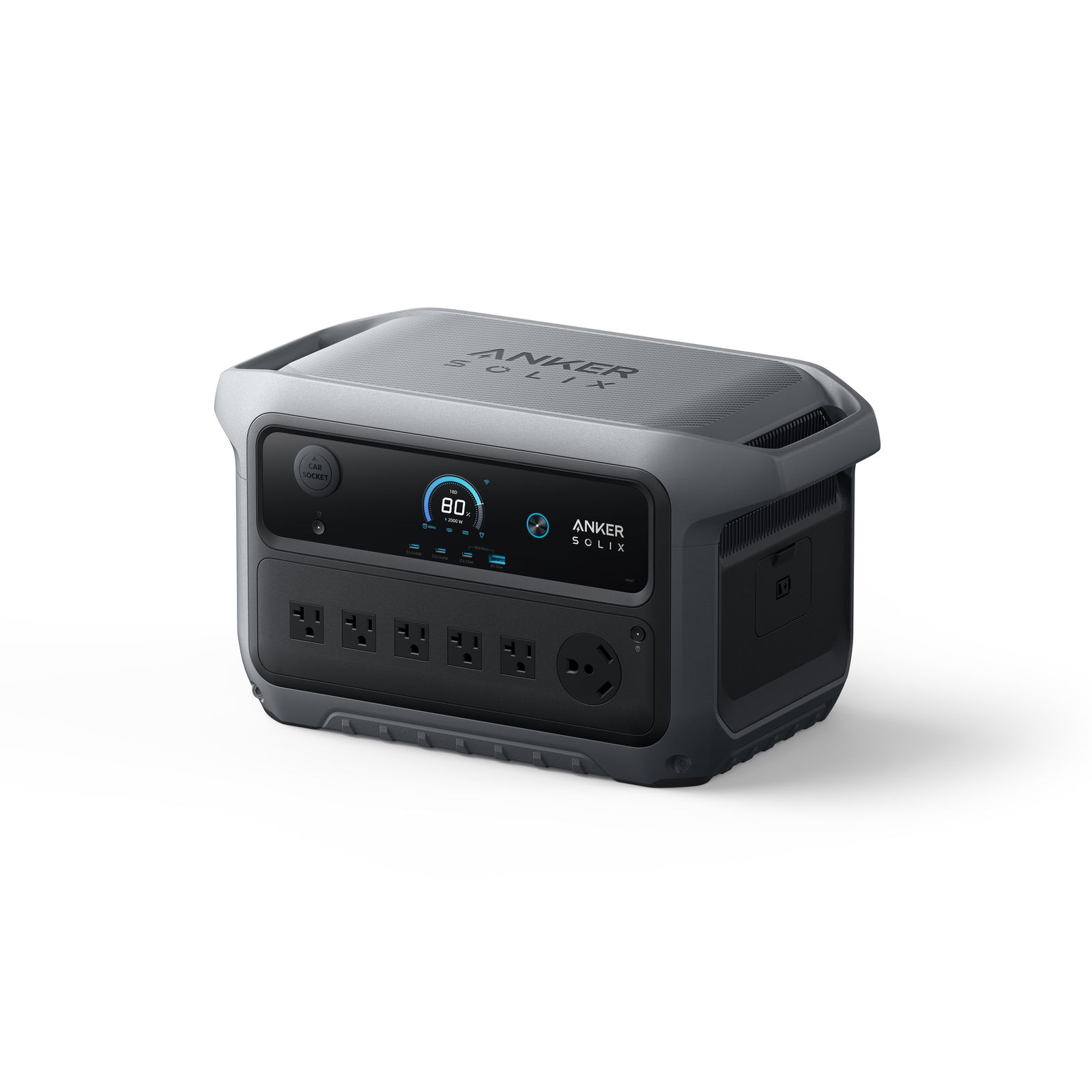
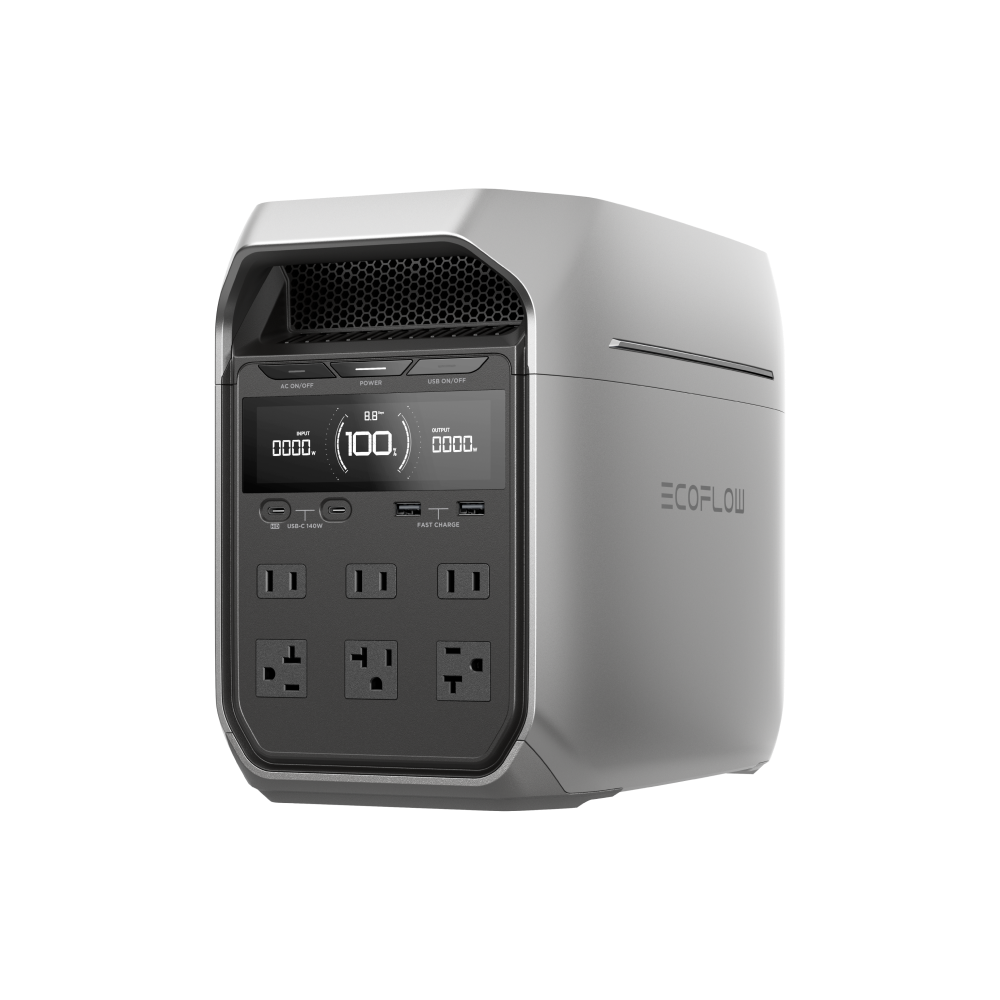
THE DIFFERENCES THAT MATTER
EcoFlow DELTA 2 vs Jackery Explorer 1000 v2: output or portability?
A practical comparison of two LFP stations around 1 kWh, focusing on continuous output, carrying weight, and device connections.
Researched from manufacturer sources. These products have not been hands-on tested for this article.
START HERE
Do you need the higher continuous AC limit, or will you carry the station often?
These stations are close in nominal energy storage but separate more clearly on continuous AC output and listed weight. That makes the right starting point your appliance list and your carry route. The comparison uses the US DELTA 2 and Explorer 1000 v2, without assuming that similarly named products or solar bundles have the same specifications.
EcoFlow DELTA 2 (US)
A good fit if: A shortlist option when 1,800 W rated output and an established DELTA 2 accessory setup meet your needs.
The tradeoff: The original model has less published solar input capacity than DELTA 3 Plus; confirm the exact legacy model in the listing.
Jackery Explorer 1000 v2 (US)
A good fit if: A shortlist option when frequent carrying matters and the combined AC load stays within 1,500 W.
The tradeoff: Its lower continuous AC limit and unequal USB-C ports need checking against your actual devices.
As an Amazon Associate I earn from qualifying purchases. How shopping links work.
DELTA 2
Find this model on Amazon : EcoFlow DELTA 2 (US) (opens in a new tab)Opens Amazon search results. Confirm the exact model, seller and bundle.Explorer 1000 v2
View this model on Amazon : Jackery Explorer 1000 v2 (US) (opens in a new tab)Check the seller, exact variant, price and included accessories.See the product photos and comparison illustration
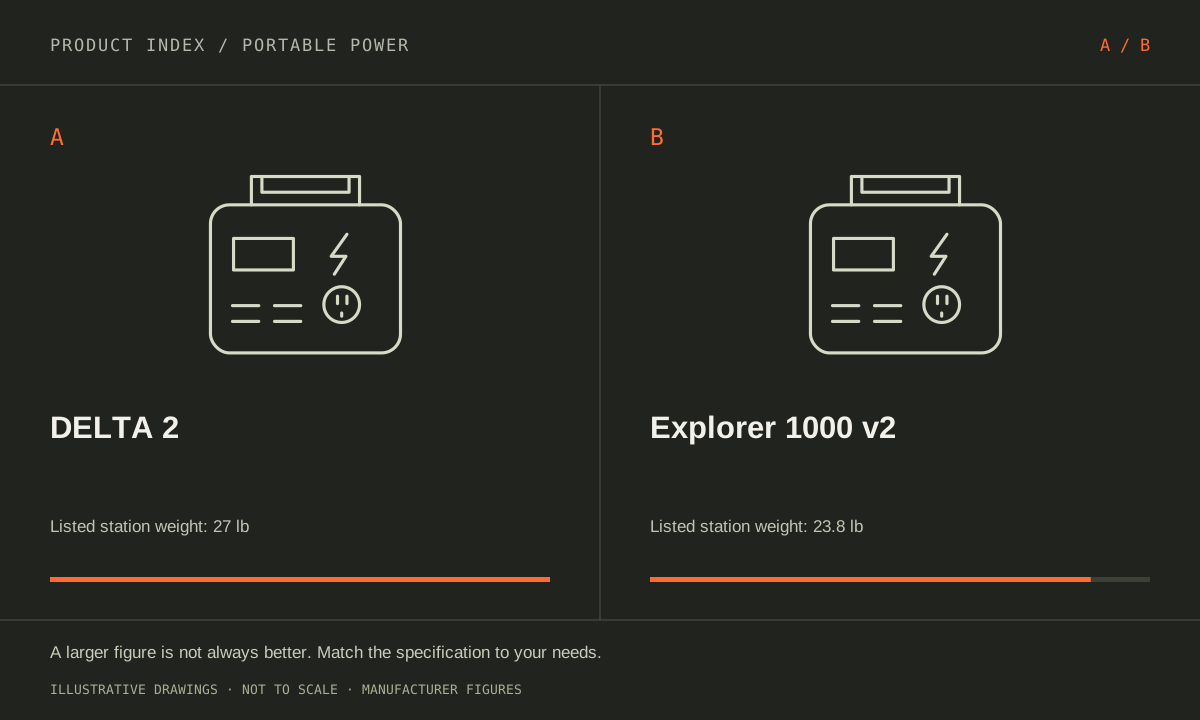
The facts, side by side.
Manufacturer specifications for the named models. On small screens, scroll the table sideways. A blank research field means the fact was not included here, not that the manufacturer does not publish it. Conditions and differently scoped specifications are kept separate.
| What matters | DELTA 2 [1] | Explorer 1000 v2 [2] |
|---|---|---|
| Battery capacity | 1,024 Wh nominal | 1,070 Wh nominal |
| Rated AC output | 1,800 W total (US) | 1,500 W total (US) |
| Weight | Approximately 27 lb / 12 kg | Approximately 23.8 lb / 10.8 kg |
| Dimensions | 400 × 211 × 281 mm | 327 × 224 × 247 mm |
| Battery chemistry | LFP | LiFePO4 (LFP) |
| USB-C output | 2 ports; up to 100 W each | 1 × up to 100 W; 1 × up to 30 W |
| Solar input maximum | 500 W; compatible voltage/current required | 400 W total; compatible voltage/current required |
Listed maximums are manufacturer claims under their stated conditions, not results from our own testing. Regional versions and bundles can differ. No live prices or stock claims are shown.
The AC load can settle this decision early
DELTA 2 lists 1,800 W of rated AC output; Explorer 1000 v2 lists 1,500 W. If the equipment you need to run together requires more than the Jackery rating but falls inside the EcoFlow rating, that is a concrete reason to investigate DELTA 2. Check starting demands as well as steady consumption, and keep those separate from a manufacturer’s surge or boost wording.
Think about a camping morning or an outage evening as a sequence of tasks. A kettle, cooking appliance, and other connected items can overlap even when you meant to use them separately. Write a realistic combined load before buying. Do not assume a power-boost feature makes every appliance suitable at the larger advertised figure. If your essential load exceeds both stations’ continuous ratings, the useful decision is to change the load plan or compare another class of station.
Manufacturer references: DELTA 2 · Explorer 1000 v2
A small energy difference and a clearer carrying difference
Jackery lists 1,070 Wh versus EcoFlow’s 1,024 Wh, a nominal difference of 46 Wh. The listed weights are approximately 23.8 lb and 27 lb respectively. I would give the weight difference more attention for repeated carrying, while avoiding a precise runtime promise from the capacity difference. The load and conversion path matter too.
Consider the most awkward move, not just the distance from a car to a picnic table. A shelf, stairs, or a narrow vehicle opening can determine whether a station is practical. Compare the full dimensions and handle arrangement with that route. If the unit will stay beside a desk almost all year, a few pounds may matter less than the output requirement. If it goes in and out of the car every weekend, the lighter listed station earns a closer look, provided it still covers your load.
Manufacturer references: DELTA 2 · Explorer 1000 v2
Build the connection plan before comparing kits
The USB-C arrangement is different: DELTA 2 lists two 100 W maximum ports, while Jackery lists one 100 W and one 30 W maximum port. For two power-hungry USB-C devices, the port assigned to each device can matter. A phone and a laptop are a different arrangement from two laptops that both need substantial charging power.
List the devices, their supported charging methods, and the cables you already own. Check solar bundles as complete electrical setups rather than matching the panel brand to the station brand and assuming that settles compatibility. Confirm exactly which panels, cables, and adapters are included. I would lean toward Jackery for frequent carrying when its output and ports fit; toward DELTA 2 when the higher continuous AC rating or two higher-power USB-C connections directly address the planned use. Neither choice deserves an automatic reliability or battery-longevity win from these specifications alone.
Manufacturer references: DELTA 2 · Explorer 1000 v2
A CLOSER LOOK AT OWNERSHIP
Beyond the specification sheet.
Additional model-specific document research checked October 20, 2026. The original comparison’s specification check date remains shown above.
Check the complete setup before ordering
DELTA 2 specifies EPS changeover within 30 ms, not uninterrupted 0 ms operation. Its AC timeout can also stop intermittent refrigerator loads; the manual directs owners needing continuous supply to set AC timeout to never in the app and monitor battery level. These are separate checks from having enough stored energy.
For Explorer 1000 v2, assign each USB-C device to a particular port before buying; its USB-C outputs are not identical. Also list simultaneous AC loads rather than counting sockets. Match the exact US v2 listing so a similarly named Plus or Pro model does not enter the comparison unnoticed.
Sources: DELTA 2 manual — EPS, storage, and operating restrictions (opens in a new tab) · EcoFlow US warranty — eligibility and service scope, not universal damage coverage (opens in a new tab) · Explorer 1000 v2 — manufacturer model information; no independent performance test (opens in a new tab) · Jackery support — models that accept expansion batteries; 1000 v2 is excluded (opens in a new tab)
Price the equipment you will actually use
Budget the DELTA 2 around the load you already own: the appropriate output cable, compatible solar arrangement if needed, and any supported extra battery. Record expansion model numbers rather than ordering by the DELTA name alone. Price a complete working setup before comparing it with a lighter station-only purchase.
Explorer 1000 v2 does not accept an expansion battery. Jackery’s supported expansion list includes 1000 Plus and 2000 Plus, not 1000 v2. If more stored energy will be necessary, price the appropriate larger or expandable station now; a later Plus-branded battery is not an upgrade path for this model.
Sources: DELTA 2 manual — EPS, storage, and operating restrictions (opens in a new tab) · EcoFlow US warranty — eligibility and service scope, not universal damage coverage (opens in a new tab) · Explorer 1000 v2 — manufacturer model information; no independent performance test (opens in a new tab) · Jackery support — models that accept expansion batteries; 1000 v2 is excluded (opens in a new tab)
Plan care, parts, and the service route
For long-term storage, the current DELTA 2 manual specifies a cycle every three months: discharge to 0%, then recharge to 60%. It also warns of warranty exclusion after more than six months without charging or discharging. This is DELTA 2 guidance, not a routine to transfer to other batteries; schedule the maintenance before putting it away.
The Explorer 1000 v2 product page presents warranty information with conditions. Confirm the extension process for your seller, the authorized service route, and return freight. Ask specifically about storage intervals and battery service. No current replacement-battery price or universal user-serviceable battery arrangement is established in this comparison.
Sources: DELTA 2 manual — EPS, storage, and operating restrictions (opens in a new tab) · EcoFlow US warranty — eligibility and service scope, not universal damage coverage (opens in a new tab) · Explorer 1000 v2 — manufacturer model information; no independent performance test (opens in a new tab) · Jackery support — models that accept expansion batteries; 1000 v2 is excluded (opens in a new tab)
What rules each option out—and when to keep what you own
Rule out either station when the verified simultaneous load, startup behavior, or required runtime does not fit. The Jackery’s lighter package is not compensation for an unsupported load, and DELTA 2’s higher rated AC ceiling is not a reason to carry extra weight if the equipment never needs it. Check intermittent-load settings before a refrigerator trial.
Keep a working station when it already completes the intended outage or travel routine. If carrying is the complaint, evaluate the entire packed kit before changing brands; panels and cables may dominate the inconvenience. If runtime is the complaint, compare a verified expansion or larger-capacity option, not merely two roughly similar nominal-energy stations.
Sources: DELTA 2 manual — EPS, storage, and operating restrictions (opens in a new tab) · EcoFlow US warranty — eligibility and service scope, not universal damage coverage (opens in a new tab) · Explorer 1000 v2 — manufacturer model information; no independent performance test (opens in a new tab) · Jackery support — models that accept expansion batteries; 1000 v2 is excluded (opens in a new tab)
THE REST OF THE BUYING DECISION
Think beyond the upgrade.
The best portable power station is the one that powers your essential equipment for the time you need, can be recharged where you use it, and is manageable to carry. Start with an equipment list, not a promotional wattage. This guide explains the decisions behind a useful shortlist; manufacturer specifications are evidence of stated capabilities, not our own runtime tests.
The portable power field guide covers the broader ownership questions, with source-specific examples. It complements this exact-model comparison; its examples do not establish features or policies for every model here.
MAKE IT YOUR DECISION
Your before-you-buy checklist.
Use this as a final check, alongside the model-specific evidence above.
Check off the questions you have resolved. Nothing is sent to a server.
Before you place the order.
- Match the full model name and generation. A similarly named bundle may have different accessories.
- Confirm the total price, seller, warranty eligibility, delivery estimate, and return terms at checkout.
- Account for any accessories or compatible equipment your setup needs. An upgrade only has value if you will use it.
Your product questions, answered.
Will Explorer 1000 v2 always run a load longer?
Its nominal capacity is slightly higher, but usable output energy depends on the conversion path and operating conditions. These figures do not establish a measured runtime winner.
Can I compare these using the biggest watt figure in a listing?
Use rated continuous AC output for the normal load plan, then check startup requirements and any surge or boost limitations separately.
Which matters more here: weight or output?
Start with the load as a pass/fail requirement, then evaluate carrying. A lighter unit is useful only after the appliance list and required duration have been satisfied.
Sources: DELTA 2 manual — EPS, storage, and operating restrictions (opens in a new tab) · EcoFlow US warranty — eligibility and service scope, not universal damage coverage (opens in a new tab) · Explorer 1000 v2 — manufacturer model information; no independent performance test (opens in a new tab) · Jackery support — models that accept expansion batteries; 1000 v2 is excluded (opens in a new tab)
Can I reuse the same solar kit?
Do not assume it. Have each manufacturer verify the complete panel arrangement, electrical limits, connector, and cable. Brand changes can alter more than the plug at the station.
Sources: DELTA 2 manual — EPS, storage, and operating restrictions (opens in a new tab) · EcoFlow US warranty — eligibility and service scope, not universal damage coverage (opens in a new tab) · Explorer 1000 v2 — manufacturer model information; no independent performance test (opens in a new tab) · Jackery support — models that accept expansion batteries; 1000 v2 is excluded (opens in a new tab)
What could stop a refrigerator after it starts?
Check overloads, available energy, and output timeout. DELTA 2’s current manual specifically warns about intermittent-load AC timeout, so include the documented settings in the acceptance test.
Sources: DELTA 2 manual — EPS, storage, and operating restrictions (opens in a new tab) · EcoFlow US warranty — eligibility and service scope, not universal damage coverage (opens in a new tab) · Explorer 1000 v2 — manufacturer model information; no independent performance test (opens in a new tab) · Jackery support — models that accept expansion batteries; 1000 v2 is excluded (opens in a new tab)
What should I compare in the warranty?
Compare seller eligibility, registration or extension rules, battery-fault treatment, freight, and the service process. Similar headline durations do not establish equivalent repair costs or coverage.
Sources: DELTA 2 manual — EPS, storage, and operating restrictions (opens in a new tab) · EcoFlow US warranty — eligibility and service scope, not universal damage coverage (opens in a new tab) · Explorer 1000 v2 — manufacturer model information; no independent performance test (opens in a new tab) · Jackery support — models that accept expansion batteries; 1000 v2 is excluded (opens in a new tab)
Sources & limitations.
Original comparison research: October 18, 2026. Individual product-source checks and ownership additions carry their own dates. These links identify the manufacturer evidence used for the specifications. Recommendations and practical implications are our editorial judgments. We have not measured performance, reliability, comfort, or long-term ownership for this comparison.
- EcoFlow DELTA 2 (US) — manufacturer specifications (opens in a new tab)
Checked October 20, 2026. - Jackery Explorer 1000 v2 (US) — manufacturer specifications (opens in a new tab)
Checked October 18, 2026.
Confirm current specifications for your region and exact bundle. Read our research and correction approach.