THE DIFFERENCES THAT MATTER
EcoFlow DELTA 2 vs DELTA 3 Plus: charging and connection differences
The same base battery capacity and rated output, but different charging inputs and USB-C limits. Choose around the equipment you will connect.
Researched from manufacturer sources. These products have not been hands-on tested for this article.
START HERE
Will the newer connections solve a problem in your actual power setup?
The DELTA 3 Plus name can suggest a bigger reserve, but the base specifications do not support that assumption. This comparison concerns the US DELTA 2 and DELTA 3 Plus stations without extra batteries or panels. I would start with the loads you already own, then ask whether a charging or connection limit makes the newer model useful.
EcoFlow DELTA 2 (US)
A good fit if: A shortlist option when 1,800 W rated output and an established DELTA 2 accessory setup meet your needs.
The tradeoff: The original model has less published solar input capacity than DELTA 3 Plus; confirm the exact legacy model in the listing.
EcoFlow DELTA 3 Plus (US)
A good fit if: A shortlist option for buyers who can use the two solar inputs or higher-power USB-C connections.
The tradeoff: Its higher input limits do not add stored energy to the base station, and compatible panels and cables add cost and bulk.
As an Amazon Associate I earn from qualifying purchases. How shopping links work.
DELTA 2
Find this model on Amazon : EcoFlow DELTA 2 (US) (opens in a new tab)Opens Amazon search results. Confirm the exact model, seller and bundle.DELTA 3 Plus
View this model on Amazon : EcoFlow DELTA 3 Plus (US) (opens in a new tab)Check the seller, exact variant, price and included accessories.See the product photos and comparison illustration
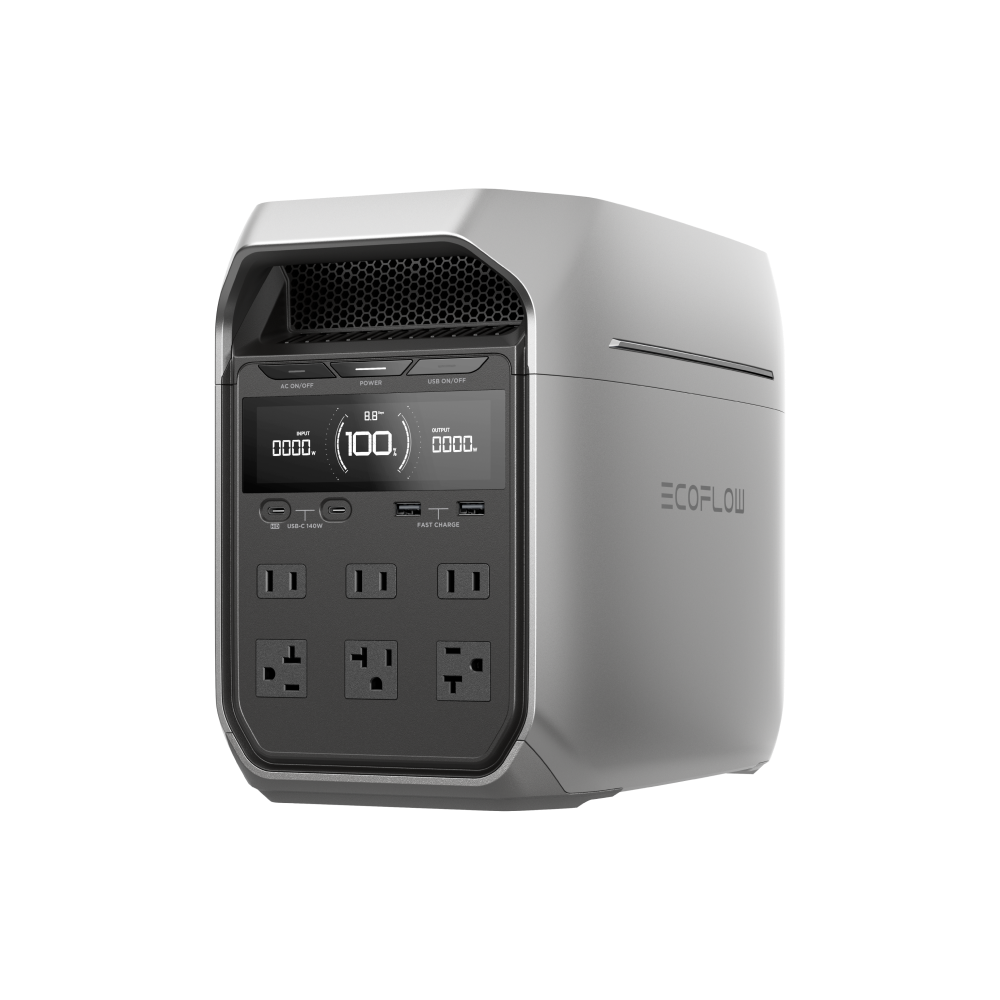
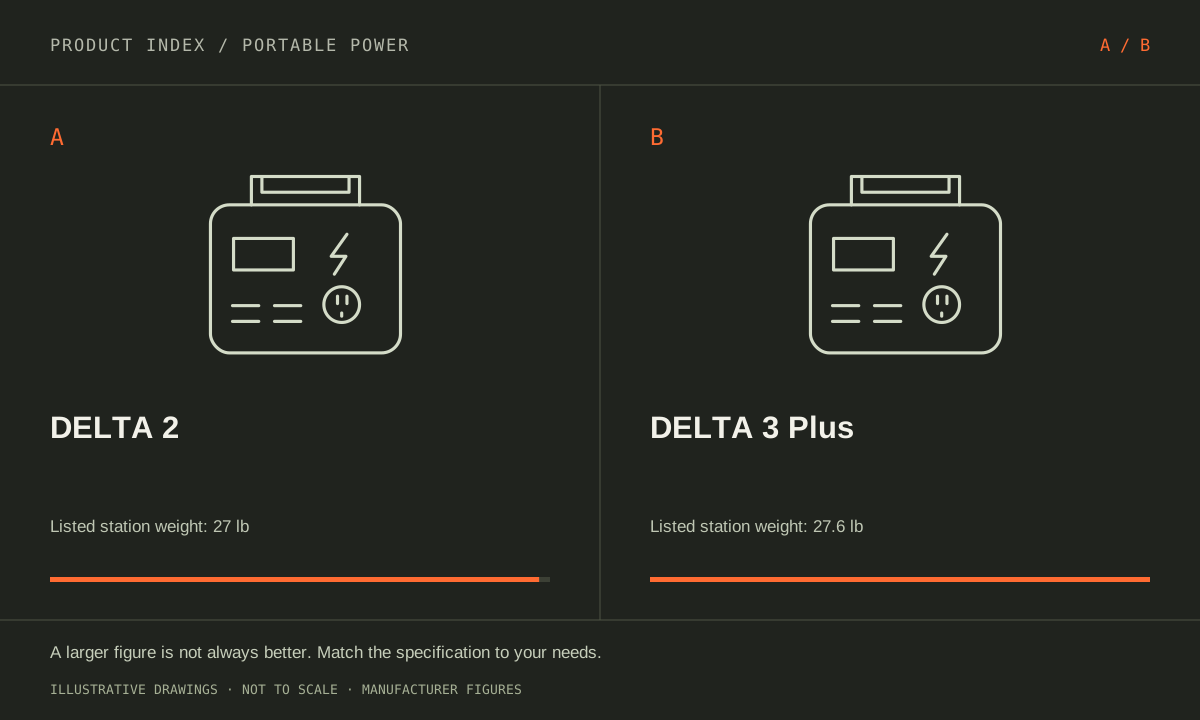
The facts, side by side.
Manufacturer specifications for the named models. On small screens, scroll the table sideways. A blank research field means the fact was not included here, not that the manufacturer does not publish it. Conditions and differently scoped specifications are kept separate.
| What matters | DELTA 2 [1] | DELTA 3 Plus [2] |
|---|---|---|
| Battery capacity | 1,024 Wh nominal | 1,024 Wh nominal |
| Rated AC output | 1,800 W total (US) | 1,800 W total (US) |
| Weight | Approximately 27 lb / 12 kg | Approximately 27.6 lb / 12.5 kg |
| Dimensions | 400 × 211 × 281 mm | 398 × 202 × 283.6 mm |
| Battery chemistry | LFP | LFP |
| USB-C output | 2 ports; up to 100 W each | 2 ports; manufacturer lists 140 W maximum |
| Solar input maximum | 500 W; compatible voltage/current required | 1,000 W total; 2 × 500 W inputs |
Listed maximums are manufacturer claims under their stated conditions, not results from our own testing. Regional versions and bundles can differ. No live prices or stock claims are shown.
Separate stored energy from output power
Both list 1,024 Wh of nominal storage and 1,800 W of rated AC output. Those equal headline figures make this a connection-and-recharging decision before it is a capacity upgrade. A watt-hour measures stored energy; a watt measures power at a moment in time. Neither figure alone tells you how long your refrigerator, monitor, or laptop will run.
Write down the appliances that must operate together and their actual requirements. A station that can start one appliance is not automatically suitable for a whole group of loads. Then decide how much time you need away from an outlet. If more stored energy is the real requirement, compare a compatible expansion setup or a larger-capacity category before paying for different ports. Conversion losses and the load pattern prevent a nominal capacity figure from becoming a guaranteed runtime.
Manufacturer references: DELTA 2 · DELTA 3 Plus
Solar and USB-C are the useful differences
DELTA 3 Plus lists two solar inputs with a 1,000 W combined maximum; DELTA 2 lists a 500 W solar maximum. The newer station also lists 140 W USB-C ports versus 100 W on DELTA 2. These are input and port ceilings, with compatible equipment required. They are not promises about the power your existing panels or computer will accept.
For a solar setup, draw the planned panel arrangement before choosing a station. Check voltage, current, connector, cable, and per-input limits in the manual. A larger permitted array can matter when you have space to deploy it and a reason to recharge between uses. If your routine is charging overnight from a wall and running modest USB devices, those extra limits may sit unused. A laptop that negotiates a lower USB-C rate will not suddenly demand the full number printed beside the socket.
Manufacturer references: DELTA 2 · DELTA 3 Plus
Check the generation before buying a bundle
The listed weights are close: about 27 lb and 27.6 lb. I would not treat either as a lightweight substitute for the other based on that small published difference. Instead, measure the storage space and think through the carry from the closet to the place of use. Keep room around the unit for the ventilation and operating clearances required by its instructions.
A seller bundle needs a separate audit. Confirm that the title, model label, included battery, and panel list all refer to the model you want; the DELTA 2 source here is its manual because a current storefront can point shoppers toward a newer product. For an existing owner, identify the exact accessories already purchased and verify compatibility before treating reuse as a saving. Choose DELTA 3 Plus when the charging layout or port requirements justify the change; keep DELTA 2 in the comparison when its existing limits cover the job.
Manufacturer references: DELTA 2 · DELTA 3 Plus
A CLOSER LOOK AT OWNERSHIP
Beyond the specification sheet.
Additional model-specific document research checked October 20, 2026. The original comparison’s specification check date remains shown above.
Backup switchover is a separate requirement from battery size
The DELTA 2 manual describes EPS transfer within 30 milliseconds and explicitly says it does not provide zero-interruption switching. EcoFlow lists under 10 milliseconds for DELTA 3 Plus. These are manufacturer claims about changeover, not measurements by The Helpful Buyer.
For a computer or network setup, identify whether the connected equipment tolerates that interruption before choosing either station. Equal battery capacity does not establish equal backup behavior. Do not interpret the faster claim as proof of compatibility with every server or other interruption-sensitive device; validate the intended equipment and shutdown arrangement.
Sources: EcoFlow DELTA 2 US manual — EPS and operating limits (opens in a new tab) · EcoFlow DELTA 3 Plus US specifications and expansion conditions (opens in a new tab)
An extra battery and a second power station are different purchases
EcoFlow documents DELTA 2 expansion using its DELTA 2 Extra Battery. The current DELTA 3 Plus US listing names DELTA 3, DELTA 2, DELTA 2 Max and DELTA Pro 3 extra batteries, and specifies an Alternator Charger XT150 Output Cable for that listed expansion arrangement. Its cable wording applies to all four listed battery families, not only DELTA Pro 3. Match the full battery and cable names before ordering.
Read the complete accessory name: owning a second station with a similar name does not establish that it can act as a compatible expansion battery. Price the required battery and connection cable together, then consider where both boxes will sit. More stored energy does not itself raise the station’s continuous AC output rating.
Sources: EcoFlow DELTA 2 US overview — expansion and warranty (opens in a new tab) · EcoFlow DELTA 3 Plus US specifications and expansion conditions (opens in a new tab)
X-Boost is not an unrestricted higher-output inverter
The DELTA 2 manual excludes equipment with strict voltage requirements from X-Boost and says that the feature is unavailable in bypass mode. Its purpose is different from supplying every appliance at a new, higher continuous wattage. EcoFlow particularly describes heating loads as the more suitable use.
If a purchase decision depends on a high-load appliance, use its actual electrical requirements and the station’s ordinary rating first. Avoid adding every advertised port maximum together or treating a surge headline as sustained output. We have not tested appliance startup or simultaneous loads, so this comparison cannot certify a near-limit combination.
Sources: EcoFlow DELTA 2 manual — X-Boost and EPS restrictions (opens in a new tab)
A stored emergency battery still needs an operating plan
The DELTA 2 manual lists charging at 32–113°F and discharging at 14–113°F, with actual battery temperature determining availability. A cold garage can therefore be acceptable for one operating function and unsuitable for another. Do not infer that a discharge temperature is also a charging temperature.
For long-term storage, the DELTA 2 manual directs owners to discharge to 0% and recharge to 60% every three months. Put that model-specific task on the calendar; it is not a universal routine for every power station. For intermittent refrigerator loads, the same manual warns about AC timeout and directs owners to set it to never in the app for continuous supply, while regularly checking battery level. A charged battery alone does not establish that the outlet will remain enabled.
Sources: EcoFlow DELTA 2 US manual — EPS and operating limits (opens in a new tab) · EcoFlow DELTA 2 US overview — expansion and warranty (opens in a new tab) · EcoFlow DELTA 3 Plus US specifications and expansion conditions (opens in a new tab)
THE REST OF THE BUYING DECISION
Think beyond the upgrade.
The best portable power station is the one that powers your essential equipment for the time you need, can be recharged where you use it, and is manageable to carry. Start with an equipment list, not a promotional wattage. This guide explains the decisions behind a useful shortlist; manufacturer specifications are evidence of stated capabilities, not our own runtime tests.
The portable power field guide covers the broader ownership questions, with source-specific examples. It complements this exact-model comparison; its examples do not establish features or policies for every model here.
MAKE IT YOUR DECISION
Your before-you-buy checklist.
Use this as a final check, alongside the model-specific evidence above.
Check off the questions you have resolved. Nothing is sent to a server.
Before you place the order.
- Match the full model name and generation. A similarly named bundle may have different accessories.
- Confirm the total price, seller, warranty eligibility, delivery estimate, and return terms at checkout.
- Account for any accessories or compatible equipment your setup needs. An upgrade only has value if you will use it.
Your product questions, answered.
Does DELTA 3 Plus store more energy than DELTA 2?
The base stations here both list 1,024 Wh. Expansion batteries are a separate purchase and compatibility question.
Does a 1,000 W solar input mean I always receive 1,000 W?
No. It is a supported maximum, subject to the electrical limits of each input and the output of the connected panels under actual conditions.
Is DELTA 2 a zero-millisecond UPS?
No. Its manual specifies transfer within 30 ms and warns that it does not meet a zero-millisecond requirement. Test the intended equipment rather than relying on capacity or output wattage.
Sources: EcoFlow DELTA 2 US manual — EPS and operating limits (opens in a new tab)
Which expansion cable does the DELTA 3 Plus listing specify?
The current US listing specifies the Alternator Charger XT150 Output Cable for its listed DELTA 3, DELTA 2, DELTA 2 Max and DELTA Pro 3 extra-battery options. Confirm the complete accessory combination before buying; a similar product name or matching-looking plug does not establish compatibility.
Sources: EcoFlow DELTA 3 Plus US specifications and expansion conditions (opens in a new tab)
Does X-Boost remain available while DELTA 2 is in bypass mode?
The DELTA 2 manual says it does not. A setup powered through the grid while the station recharges has different constraints from battery-only operation.
Sources: EcoFlow DELTA 2 manual — X-Boost and EPS restrictions (opens in a new tab)
Does 1,024 Wh mean ten hours for a 100 W appliance?
Dividing 1,024 Wh by a continuous 100 W gives an ideal 10.24 hours before conversion losses, inverter consumption or reserve. This arithmetic is a planning ceiling, not a measured runtime. A refrigerator also cycles and has startup demands, so use measured energy consumption and confirm startup compatibility rather than relying on its running wattage alone.
Sources: EcoFlow DELTA 2 US manual — EPS and operating limits (opens in a new tab)
Sources & limitations.
Original comparison research: October 18, 2026. Individual product-source checks and ownership additions carry their own dates. These links identify the manufacturer evidence used for the specifications. Recommendations and practical implications are our editorial judgments. We have not measured performance, reliability, comfort, or long-term ownership for this comparison.
- EcoFlow DELTA 2 (US) — manufacturer specifications (opens in a new tab)
Checked October 20, 2026. - EcoFlow DELTA 3 Plus (US) — manufacturer specifications (opens in a new tab)
Checked October 18, 2026.
Confirm current specifications for your region and exact bundle. Read our research and correction approach.