THE DIFFERENCES THAT MATTER
Breville Barista Express vs Touch: learning a craft or simplifying milk drinks?
Compare manual milk and analog feedback with automatic texturing, saved drinks, and ThermoJet heating on the BES880 Touch.
Researched from manufacturer sources. These products have not been hands-on tested for this article.
START HERE
Which parts of making a latte do you want to practice, and which do you want simplified?
The Express and Touch represent meaningfully different ways to interact with a home espresso machine. The Express BES870 emphasizes a hands-on routine with manual milk; the Touch BES880 adds automatic texturing and a touchscreen. Both keep you involved in preparing the coffee. Decide how much assistance you want before treating the Touch as an obvious upgrade.
Breville Barista Express BES870
A good fit if: For someone who wants to learn a manual espresso and milk routine.
The tradeoff: Milk technique and grind adjustments remain your responsibility.
Breville Barista Touch BES880
A good fit if: For milk-drink households that want saved drink settings and automatic milk texturing.
The tradeoff: You still prepare the portafilter, tamp, move it, and clean the machine.
As an Amazon Associate I earn from qualifying purchases. How shopping links work.
Barista Express
View this model on Amazon : Breville Barista Express BES870 (opens in a new tab)Check the seller, exact variant, price and included accessories.Barista Touch
View this model on Amazon : Breville Barista Touch BES880 (opens in a new tab)Check the seller, exact variant, price and included accessories.See the product photos and comparison illustration
The facts, side by side.
Manufacturer specifications for the named models. On small screens, scroll the table sideways. A blank research field means the fact was not included here, not that the manufacturer does not publish it. Conditions and differently scoped specifications are kept separate.
| What matters | Barista Express [1] | Barista Touch [2] |
|---|---|---|
| Model | BES870 | BES880 |
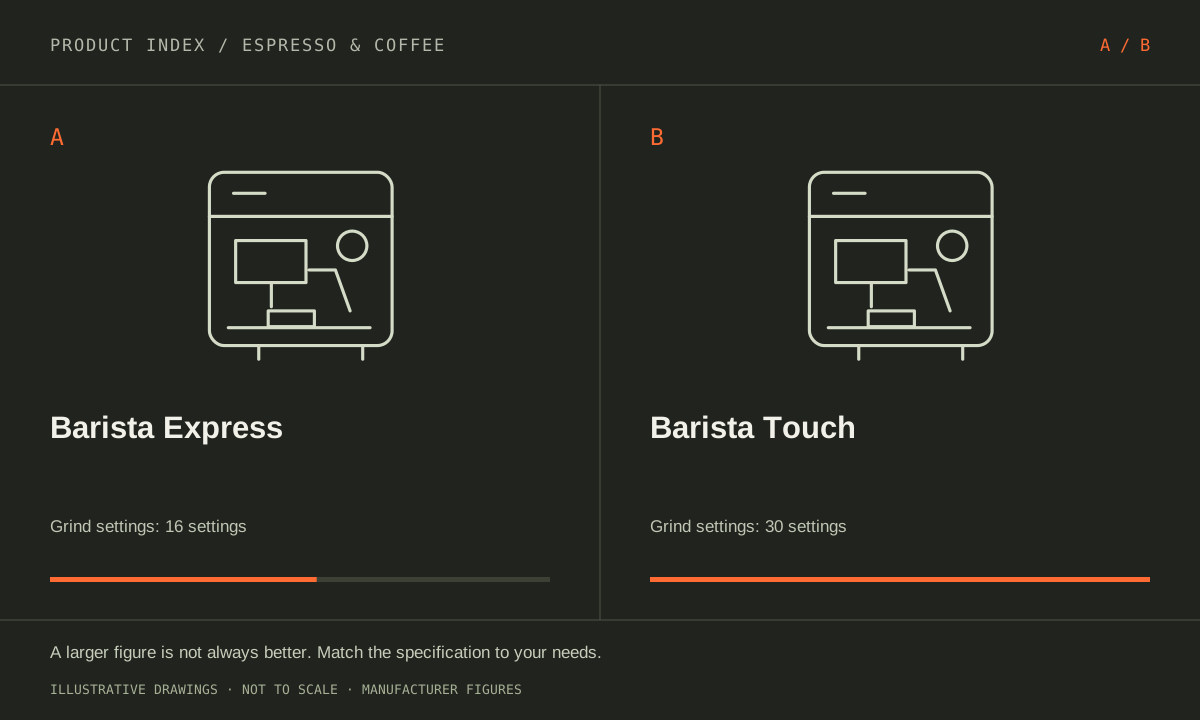
| Grind settings | 16 | 30 |
| Heating | Thermocoil with PID temperature control | ThermoJet; manufacturer claims 3-second heat-up |
| Milk texturing | Manual steam wand | Automatic temperature and texture; manual option |
| Interface | Buttons and analog pressure gauge | Touchscreen; up to 8 personalized coffees |
| Extraction | Low-pressure pre-infusion; 9-bar extraction | Low-pressure pre-infusion; 9-bar extraction |
Listed maximums are manufacturer claims under their stated conditions, not results from our own testing. Regional versions and bundles can differ. No live prices or stock claims are shown.
A manual milk routine can be a benefit or a barrier
The Express makes sense for someone who wants to learn how a steam wand changes milk texture. That practice is part of the product experience. The Touch changes the assignment by letting you select automatic milk temperature and texture, while retaining a manual option. A buyer excited by latte preparation may value hands-on control; a buyer making a quick drink before leaving home may value reducing the number of judgments needed during preparation.
Ask everyone who will use the machine, because a shared kitchen can contain both preferences. The Touch’s manual option gives an interested owner room to experiment while another person uses automatic texturing. The Express requires the manual skill from whoever wants a milk drink. Neither choice is inherently more serious about coffee. The useful distinction is whether learning that skill is something your household wants to do regularly, rather than something it would tolerate to get a latte.
Manufacturer references: Barista Express · Barista Touch
The Touch adds assistance without becoming fully hands-off
The Touch can store up to eight personalized coffees and uses a touchscreen menu. It also lists 30 grinder settings compared with 16 on the Express. Those features can make it easier to revisit preferences and choose smaller grinder adjustments. They do not eliminate dosing, tamping, moving the portafilter, knocking out grounds, or cleaning. A buyer disappointed by those tasks would still encounter them after choosing the touchscreen model.
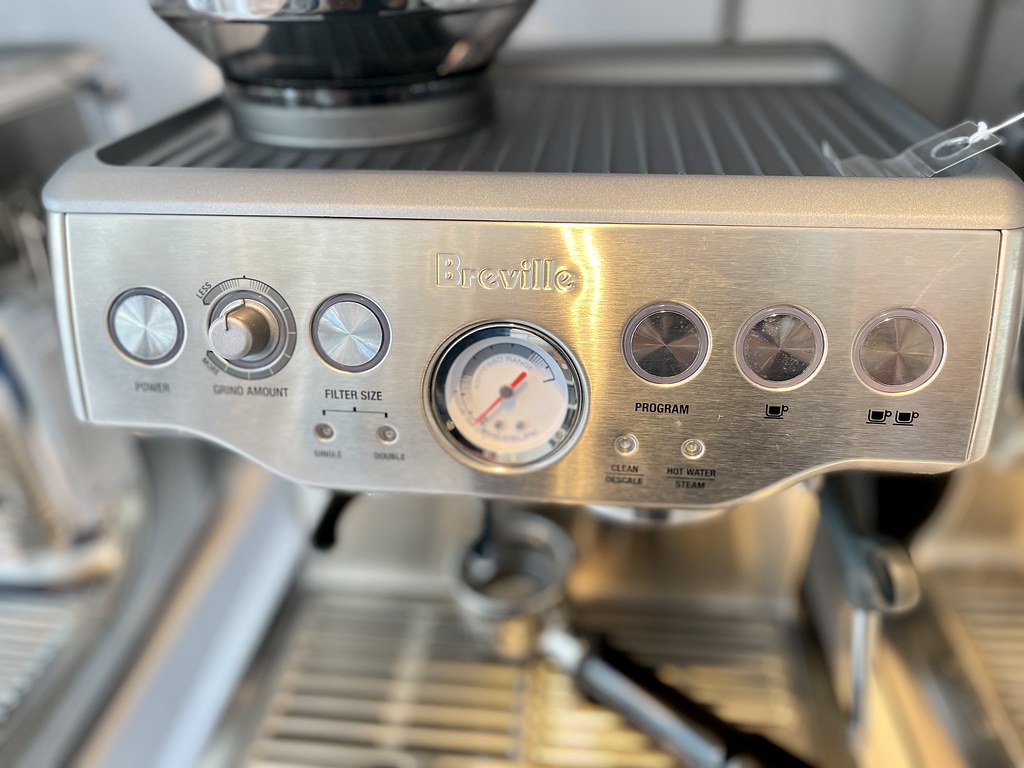
The Express provides physical buttons and an analog pressure gauge. That layout may appeal if you want to interact directly with the brewing process and do not need named drink profiles. For a household that alternates between several milk preferences, saved settings have a clearer role. Imagine an ordinary weekday sequence all the way to rinsing the pitcher. Judge the interface by which decisions it helps you make in that sequence, not by how modern the display looks.
Manufacturer references: Barista Express · Barista Touch
Treat the heater change as one part of the purchase
The Express uses Thermocoil heating with PID temperature control. Breville gives the Touch’s ThermoJet heater a three-second claim for reaching extraction temperature. If you turn the machine on several times per day, heater startup may influence your experience. That figure does not include grinding and preparing the coffee or completing a milk drink. We have no measured complete-drink timing comparison, so do not convert it into a guaranteed number of minutes saved each morning.
Our conditional choice is the Express for someone who wants a manual learning process and finds the current package financially comfortable. The Touch is a more persuasive option when automatic milk, saved preferences, and faster heater startup all solve real frustrations. Check the live price difference, the model code, and your available work surface before ordering. If your present machine already makes drinks you enjoy, identify the specific step you want changed before replacing an entire setup.
Manufacturer references: Barista Express · Barista Touch
A CLOSER LOOK AT OWNERSHIP
Beyond the specification sheet.
Additional model-specific document research checked October 20, 2026. The original comparison’s specification check date remains shown above.
Set up the version you are actually buying
The Barista Express needs room for a complete manual espresso routine, including milk texturing and emptying the drip tray. Its analog gauge is feedback rather than an automatic correction system. Plan a repeatable place for preparing the portafilter and putting wet tools down; this is especially important if the machine will sit below cabinets or beside the sink.
Automatic milk on the BES880 depends on positioning: its manual places the jug on the temperature sensor in the drip tray, with the steam wand fully lowered and milk covering the ring around the tip. This is useful assistance for a shared kitchen, but the user still fills and positions the jug. Milk brands and alternatives may need different texture settings; saved preferences do not make their behavior identical.
Sources: Breville Barista Express BES870 — official model information (opens in a new tab) · Breville Barista Touch BES880 — official model information (opens in a new tab) · Breville water and hardness guidance (opens in a new tab) · Breville BES880 — US milk sensor, filter and cleaning instructions (opens in a new tab)
Price the useful package and recurring supplies
For the BES870, verify every accessory against the exact model rather than buying from a generic Barista-family listing. The built-in grinder can make the initial shopping list smaller, but cleaning supplies and water care remain recurring items. Keep a functioning Express when its manual workflow suits you; identify a specific limitation before paying to replace the whole integrated setup.
The BES880 instruction book includes a milk jug, cleaning disc and tablets, and both single-wall and dual-wall baskets; it assigns the dual-wall baskets to pre-ground coffee. Occasional pre-ground decaf therefore has a documented route without a second grinder. This manual recommends replacing its water filter after three months. Use the instructions supplied with the exact filter and machine rather than importing the Pro’s different documented interval.
Sources: Breville Barista Express BES870 — official model information (opens in a new tab) · Breville water and hardness guidance (opens in a new tab) · Breville espresso maintenance — general guidance; use the model procedure (opens in a new tab) · Breville US warranty terms (opens in a new tab) · Breville direct-store return policy (opens in a new tab) · Breville Barista Touch BES880 — official model information (opens in a new tab) · Breville BES880 — US milk sensor, filter and cleaning instructions (opens in a new tab)
Understand maintenance, repair and service scope
For Barista Express: Breville separates coffee-path cleaning, descaling, grinder care and milk-wand care. Use the exact model procedure rather than copying a cycle from another machine. Our ownership recommendation is to check whether the daily milk cleanup and occasional longer maintenance fit your schedule before paying for more automation; the touchscreen or heater does not perform all those jobs for you.
For Barista Touch: Breville’s US warranty process asks for model/batch or serial identification and a sales receipt. For an eligible service or replacement claim, it supplies a prepaid shipping label. This differs from a change-of-mind return: the direct-store policy allows eligible appliances within 30 days of receipt only in brand-new condition with original packaging and accessories, and excludes parts/accessory refunds. A retailer purchase follows that retailer’s return process.
Sources: Breville Barista Express BES870 — official model information (opens in a new tab) · Breville water and hardness guidance (opens in a new tab) · Breville espresso maintenance — general guidance; use the model procedure (opens in a new tab) · Breville US warranty terms (opens in a new tab) · Breville direct-store return policy (opens in a new tab) · Breville Barista Touch BES880 — official model information (opens in a new tab) · Breville BES880 — US milk sensor, filter and cleaning instructions (opens in a new tab)
What rules one out—and when to keep what you own
Touch is worth considering when automated milk and saved drinks solve daily friction; Express remains coherent for someone who enjoys tactile, manual preparation. Rule out both when the brief is a machine that completes the entire drink without portafilter handling. Their integrated grinders do not turn either into a fully automatic brew unit.
For an existing Express owner, write down the exact interruption you want to remove. If the answer is inconsistent milk technique, Touch addresses a relevant task. If you already like the drinks and routine, its additional interface does not establish a reason to discard a functioning machine. Test the practical difference rather than upgrading because the display looks newer.
Sources: Breville Barista Express BES870 — official model information (opens in a new tab) · Breville water and hardness guidance (opens in a new tab) · Breville espresso maintenance — general guidance; use the model procedure (opens in a new tab) · Breville US warranty terms (opens in a new tab) · Breville direct-store return policy (opens in a new tab) · Breville Barista Touch BES880 — official model information (opens in a new tab) · Breville BES880 — US milk sensor, filter and cleaning instructions (opens in a new tab)
THE REST OF THE BUYING DECISION
Think beyond the upgrade.
Start with the drink, the number of people and the amount of work you want to do. This guide turns manufacturer instructions into practical buying questions for espresso machines, grinders and filter brewers. Our recommendations are editorial judgments from documentation; we have not measured taste, reliability or speed in a test kitchen.
The espresso & coffee field guide covers the broader ownership questions, with source-specific examples. It complements this exact-model comparison; its examples do not establish features or policies for every model here.
MAKE IT YOUR DECISION
Your before-you-buy checklist.
Use this as a final check, alongside the model-specific evidence above.
Check off the questions you have resolved. Nothing is sent to a server.
Before you place the order.
- Match the full model name and generation. A similarly named bundle may have different accessories.
- Confirm the total price, seller, warranty eligibility, delivery estimate, and return terms at checkout.
- Account for any accessories or compatible equipment your setup needs. An upgrade only has value if you will use it.
Your product questions, answered.
Is the Barista Touch fully automatic from bean to cup?
It still requires separate portafilter preparation and cleaning steps. Its touchscreen and automatic milk texturing do not remove that workflow.
Does the Express have temperature control?
Breville lists PID temperature control with its Thermocoil heating system. Its heater design differs from the Touch’s ThermoJet system.
Can I reuse every Express accessory with Touch?
Do not assume that. Match the actual BES870 and BES880 part numbers, including baskets, handles and filters. A shared brand or nominal size is not complete fit evidence.
Sources: Breville Barista Express BES870 — official model information (opens in a new tab) · Breville water and hardness guidance (opens in a new tab) · Breville espresso maintenance — general guidance; use the model procedure (opens in a new tab) · Breville US warranty terms (opens in a new tab) · Breville direct-store return policy (opens in a new tab) · Breville Barista Touch BES880 — official model information (opens in a new tab) · Breville BES880 — US milk sensor, filter and cleaning instructions (opens in a new tab)
What would make neither machine a good fit?
Wanting brewed filter coffee in large batches, or wanting to avoid manual portafilter preparation, points to a different machine type rather than the more expensive model in this pair.
Sources: Breville Barista Express BES870 — official model information (opens in a new tab) · Breville water and hardness guidance (opens in a new tab) · Breville espresso maintenance — general guidance; use the model procedure (opens in a new tab) · Breville US warranty terms (opens in a new tab) · Breville direct-store return policy (opens in a new tab) · Breville Barista Touch BES880 — official model information (opens in a new tab) · Breville BES880 — US milk sensor, filter and cleaning instructions (opens in a new tab)
What should an Express owner test before buying Touch?
Compare the milk step with the drink you normally make. If automatic texturing does not resolve a real annoyance, the screen and saved choices may be a preference rather than a necessary replacement.
Sources: Breville Barista Express BES870 — official model information (opens in a new tab) · Breville water and hardness guidance (opens in a new tab) · Breville espresso maintenance — general guidance; use the model procedure (opens in a new tab) · Breville US warranty terms (opens in a new tab) · Breville direct-store return policy (opens in a new tab) · Breville Barista Touch BES880 — official model information (opens in a new tab) · Breville BES880 — US milk sensor, filter and cleaning instructions (opens in a new tab)
How much counter space should I measure?
Include access to the hopper and tank, removing the drip tray, tamping and moving a milk jug. A measurement of the closed machine alone misses the workspace shared by both preparation routines.
Sources: Breville Barista Express BES870 — official model information (opens in a new tab) · Breville water and hardness guidance (opens in a new tab) · Breville espresso maintenance — general guidance; use the model procedure (opens in a new tab) · Breville US warranty terms (opens in a new tab) · Breville direct-store return policy (opens in a new tab) · Breville Barista Touch BES880 — official model information (opens in a new tab) · Breville BES880 — US milk sensor, filter and cleaning instructions (opens in a new tab)
Sources & limitations.
Original comparison research: October 18, 2026. Individual product-source checks and ownership additions carry their own dates. These links identify the manufacturer evidence used for the specifications. Recommendations and practical implications are our editorial judgments. We have not measured performance, reliability, comfort, or long-term ownership for this comparison.
- Breville Barista Express BES870 — manufacturer specifications (opens in a new tab)
Checked October 18, 2026. - Breville Barista Touch BES880 — manufacturer specifications (opens in a new tab)
Checked October 18, 2026.
Confirm current specifications for your region and exact bundle. Read our research and correction approach.