
THE DIFFERENCES THAT MATTER
Breville Barista Express vs Pro: faster startup or a simpler espresso routine?
Compare the BES870 and BES878 on heating, grinder adjustment, and manual milk preparation before choosing your daily coffee setup.
Researched from manufacturer sources. These products have not been hands-on tested for this article.
START HERE
Will faster heater startup and more grinder settings improve the way you make coffee?
The Barista Pro changes the pace and feedback of a hands-on espresso routine. The Express keeps an analog pressure gauge and a Thermocoil heater; the Pro adds an LCD, a ThermoJet heater, and more grinder settings. Both still ask you to learn coffee preparation and steam milk manually. Our recommendation turns on those workflow differences, based on the manufacturer documents.
Breville Barista Express BES870
A good fit if: For someone who wants to learn a manual espresso and milk routine.
The tradeoff: Milk technique and grind adjustments remain your responsibility.
Breville Barista Pro BES878
A good fit if: For an espresso learner who wants fast heater startup and a screen while keeping manual milk control.
The tradeoff: The faster heater does not automate puck preparation or milk texturing.
As an Amazon Associate I earn from qualifying purchases. How shopping links work.
Barista Express
View this model on Amazon : Breville Barista Express BES870 (opens in a new tab)Check the seller, exact variant, price and included accessories.Barista Pro
View this model on Amazon : Breville Barista Pro BES878 (opens in a new tab)Check the seller, exact variant, price and included accessories.See the product photos and comparison illustration
The facts, side by side.
Manufacturer specifications for the named models. On small screens, scroll the table sideways. A blank research field means the fact was not included here, not that the manufacturer does not publish it. Conditions and differently scoped specifications are kept separate.
| What matters | Barista Express [1] | Barista Pro [2] |
|---|---|---|
| Model | BES870 | BES878 |
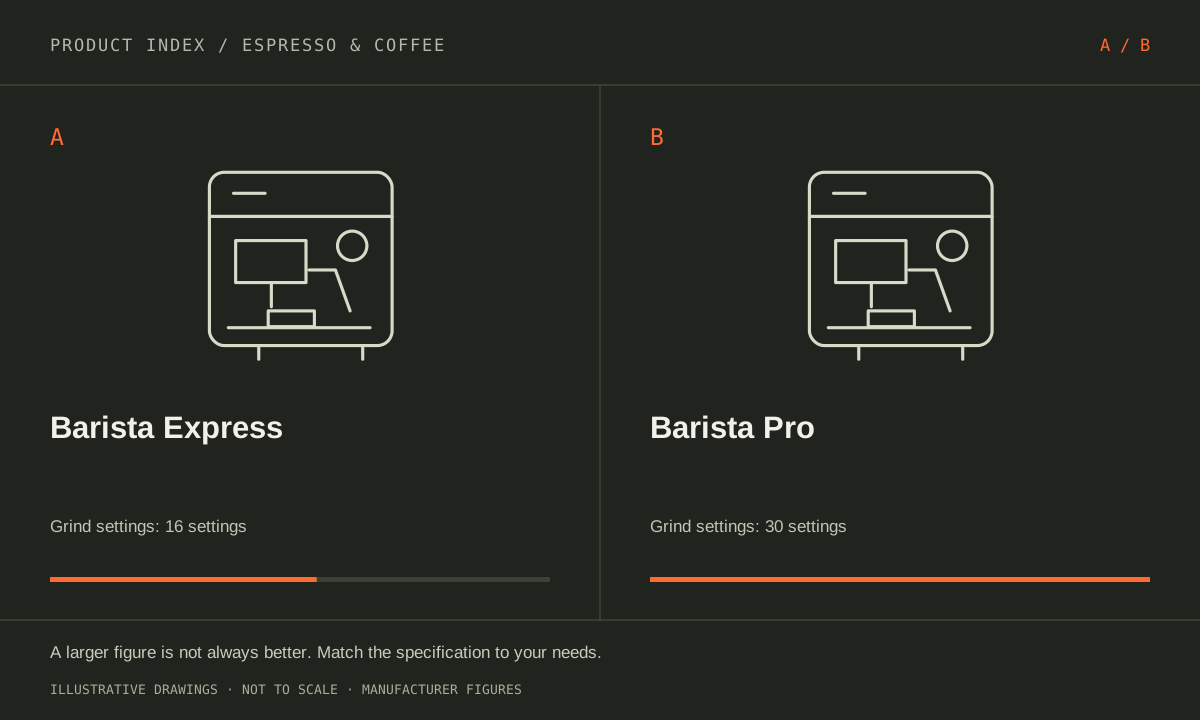
| Grind settings | 16 | 30 |
| Heating | Thermocoil with PID temperature control | ThermoJet; manufacturer claims 3-second heat-up |
| Milk texturing | Manual steam wand | Manual steam wand |
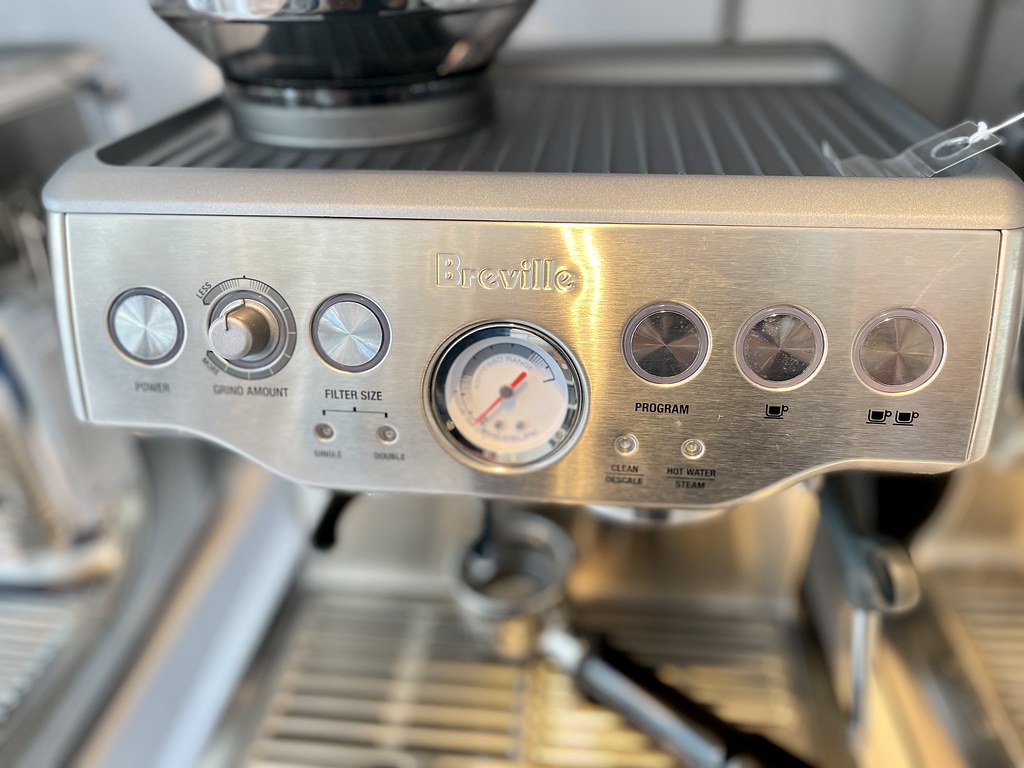
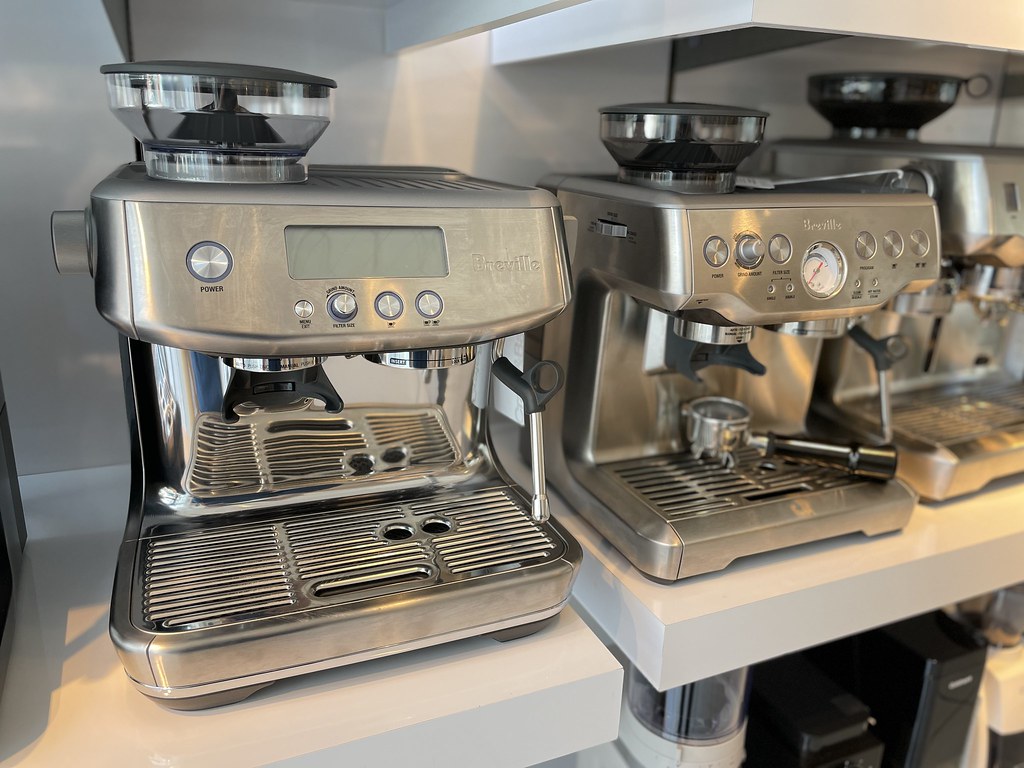
| Interface | Buttons and analog pressure gauge | LCD and physical controls |
| Extraction | Low-pressure pre-infusion; 9-bar extraction | Low-pressure pre-infusion; 9-bar extraction |
Listed maximums are manufacturer claims under their stated conditions, not results from our own testing. Regional versions and bundles can differ. No live prices or stock claims are shown.
Separate heater readiness from a finished drink
Breville gives the Pro a three-second heating claim for reaching extraction temperature. The Express uses Thermocoil heating with PID temperature control. That is a meaningful hardware distinction if you repeatedly switch the machine on for a single coffee. It is also a narrower promise than a three-second espresso: weighing beans, grinding, distributing, tamping, brewing, and cleaning still take time. Think about the part of your current morning that actually causes the delay.
For someone making several coffees in one sitting, initial heater startup may be less important than preparation and milk technique. The Pro makes sense when its quicker startup solves a recurring annoyance. The Express remains a reasonable candidate when you enjoy an unhurried ritual and do not need the newer interface. Neither specification lets us promise a faster complete latte or a better-tasting shot in your kitchen; those are different questions that require testing.
Manufacturer references: Barista Express · Barista Pro
More grinder settings offer more adjustment points
The documented grinder range is 16 settings on the Express and 30 on the Pro. More selectable positions can be useful when trying to make a smaller adjustment between one extraction and the next. That makes the Pro worth considering if you change beans often and want more steps available on the built-in grinder. The count alone does not establish grind consistency, burr longevity, or an automatic improvement in flavor; we have not measured those outcomes.
A first-time owner should plan to learn either grinder. Choosing the Pro does not remove the need to adjust a recipe when beans change. Start with a repeatable dose, observe the extraction, and change one variable at a time using the instructions. If that process sounds appealing, both machines fit the basic brief. If you want the machine to diagnose and correct every shot, these published features do not establish that either machine provides that experience.
Manufacturer references: Barista Express · Barista Pro
Choose the feedback you want while learning
The Express presents buttons and an analog pressure gauge; the Pro uses an LCD and physical controls. A screen can make settings easier to revisit, while a gauge may appeal to someone who likes a visible mechanical-style reference during brewing. The more important shared feature for latte drinkers is the manual steam wand. You will need to develop your own milk technique on either machine, so the Pro is not a milk-automation upgrade.
Before purchasing, picture making two different drinks back to back. Decide whether you want the Pro’s screen and heater enough to justify the current seller price difference, then check the exact BES870 or BES878 package. Allow counter space for the pitcher, used grounds, and cleaning supplies as well as the machine. We would choose the Pro for startup and adjustment preferences, and the Express when its manual controls already satisfy the routine. There is no universal winner from specifications alone.
Manufacturer references: Barista Express · Barista Pro
A CLOSER LOOK AT OWNERSHIP
Beyond the specification sheet.
Additional model-specific document research checked October 20, 2026. The original comparison’s specification check date remains shown above.
The cleaning cycle is not the descaling cycle
The Express manual distinguishes a flashing CLEAN/DESCALE reminder for back-flushing from a steady descaling reminder. The Pro instead presents a FLUSH alert on its display. Both manuals separate coffee-path cleaning from mineral-scale removal: completing one job does not mean the other has been done.
For a first espresso machine, budget time and consumables for both tasks, plus everyday milk-wand and grounds cleanup. The Pro changes the way the reminder is communicated; that alone is not evidence that it needs less maintenance. Compare the care instructions with the routine you will realistically keep.
Sources: Breville BES870 US instruction book — basket choice and care (opens in a new tab) · Breville BES878 US instruction book — setup, filters and cleaning (opens in a new tab)
Plan the refill route, not just the counter footprint
The Pro manual describes lifting the water tank up and away from the back of the machine. It recommends a water-filter change after two months, more often in hard-water areas, and warns against distilled, demineralized or highly filtered water. The supplied filter is an ongoing purchase, not a permanent part.
A machine under a low cupboard therefore needs a practical refilling and hopper-access plan. Before ordering, mock up the location with room to remove the tank and reach supplies. We have not measured the extra clearance required in your kitchen; the published body dimensions do not answer that question.
Sources: Breville BES878 US instruction book — setup, filters and cleaning (opens in a new tab)
You can start with pre-ground coffee, but use the right basket
The Express instructions assign dual-wall baskets to pre-ground coffee and single-wall baskets to freshly ground beans. The Pro product listing includes both basket types, a milk jug, cleaning kit and water filter. This makes the included kit more relevant than an accessory bundle with a long but vague title.
The Express manual gives a starting basket dose of 8–11 g for one cup and 16–19 g for two cups. The basket describes the coffee dose, not the size of a finished latte. For two milk drinks, plan the coffee, milk-texturing and cleanup steps rather than assuming a two-cup basket makes two complete drinks automatically. Pre-ground decaf with the appropriate dual-wall basket can avoid a second grinder; the result still depends on the coffee and preparation.
Sources: Breville BES870 US instruction book — basket choice and care (opens in a new tab) · Breville Barista Pro US product specifications and included accessories (opens in a new tab)
Treat service coverage as part of the purchase
Breville’s US warranty process asks for product identification and proof of purchase, then directs the owner to Consumer Support. An eligible claim can involve shipping the machine for repair or replacement; a warranty is not a promise of an immediate countertop replacement.
Keep the receipt and photograph the serial/model label while it is easy to reach. Compare the seller’s return window separately from Breville’s limited warranty. The Pro’s US product specifications state a two-year limited warranty, but verify the exact Express offer and applicable terms rather than assuming the two packages have identical coverage.
Sources: Breville US limited warranty and claim process (opens in a new tab) · Breville Barista Pro US product specifications and included accessories (opens in a new tab)
THE REST OF THE BUYING DECISION
Think beyond the upgrade.
Start with the drink, the number of people and the amount of work you want to do. This guide turns manufacturer instructions into practical buying questions for espresso machines, grinders and filter brewers. Our recommendations are editorial judgments from documentation; we have not measured taste, reliability or speed in a test kitchen.
The espresso & coffee field guide covers the broader ownership questions, with source-specific examples. It complements this exact-model comparison; its examples do not establish features or policies for every model here.
MAKE IT YOUR DECISION
Your before-you-buy checklist.
Use this as a final check, alongside the model-specific evidence above.
Check off the questions you have resolved. Nothing is sent to a server.
Before you place the order.
- Match the full model name and generation. A similarly named bundle may have different accessories.
- Confirm the total price, seller, warranty eligibility, delivery estimate, and return terms at checkout.
- Account for any accessories or compatible equipment your setup needs. An upgrade only has value if you will use it.
Your product questions, answered.
Does the Pro automatically steam milk?
The cited BES878 model uses manual milk texturing, as does the BES870 Express.
Does three-second heat-up mean coffee in three seconds?
No. Breville’s claim concerns the ThermoJet heater reaching extraction temperature, not the full preparation and brewing process.
Does running a cleaning tablet also remove scale?
No. Breville separates the back-flush/cleaning cycle from descaling in the Express instructions. Follow the indicated procedure for the actual maintenance reminder.
Sources: Breville BES870 US instruction book — basket choice and care (opens in a new tab)
Will the Pro fit under a cupboard if its body fits?
Not necessarily. Its tank lifts from the rear, so leave working access as well as body clearance. Measure the intended location; we have not established a universal extra-clearance figure.
Sources: Breville BES878 US instruction book — setup, filters and cleaning (opens in a new tab)
Do I need to buy a milk jug and baskets separately for the Pro?
The cited US listing includes a jug and single- and dual-wall baskets. Check the seller’s exact package, especially for used or refurbished offers, before adding duplicates.
Sources: Breville Barista Pro US product specifications and included accessories (opens in a new tab)
How much coffee does the Express basket use?
Breville specifies 8–11 g for the one-cup basket and 16–19 g for the two-cup basket as starting amounts. Use the correct basket and adjust the grind and dose as the manual directs. These are coffee amounts, not finished-drink volumes.
Sources: Breville BES870 US instruction book — basket choice and care (opens in a new tab)
Sources & limitations.
Original comparison research: October 18, 2026. Individual product-source checks and ownership additions carry their own dates. These links identify the manufacturer evidence used for the specifications. Recommendations and practical implications are our editorial judgments. We have not measured performance, reliability, comfort, or long-term ownership for this comparison.
- Breville Barista Express BES870 — manufacturer specifications (opens in a new tab)
Checked October 18, 2026. - Breville Barista Pro BES878 — manufacturer specifications (opens in a new tab)
Checked October 18, 2026.
Confirm current specifications for your region and exact bundle. Read our research and correction approach.