THE DIFFERENCES THAT MATTER
Nikon Z f vs Fujifilm X-T5: full-frame lens plan or high-resolution APS-C kit?
Compare dial-based cameras on sensor format, screen movement, storage and ready-to-shoot body weight.
Researched from manufacturer sources. These products have not been hands-on tested for this article.
START HERE
Does your lens and output plan suit Nikon full frame or Fujifilm’s 40.2 MP APS-C system?
Nikon Z f and Fujifilm X-T5 both provide dedicated exposure dials and sensor-shift stabilization, but they are different systems beneath that control layout. Nikon lists 24.5 effective megapixels on a full-frame sensor; Fujifilm lists 40.2 megapixels on APS-C. That does not establish a universal image-quality winner. Build the required lenses and file workflow first, then examine screen movement, storage and the weight of the complete kit.
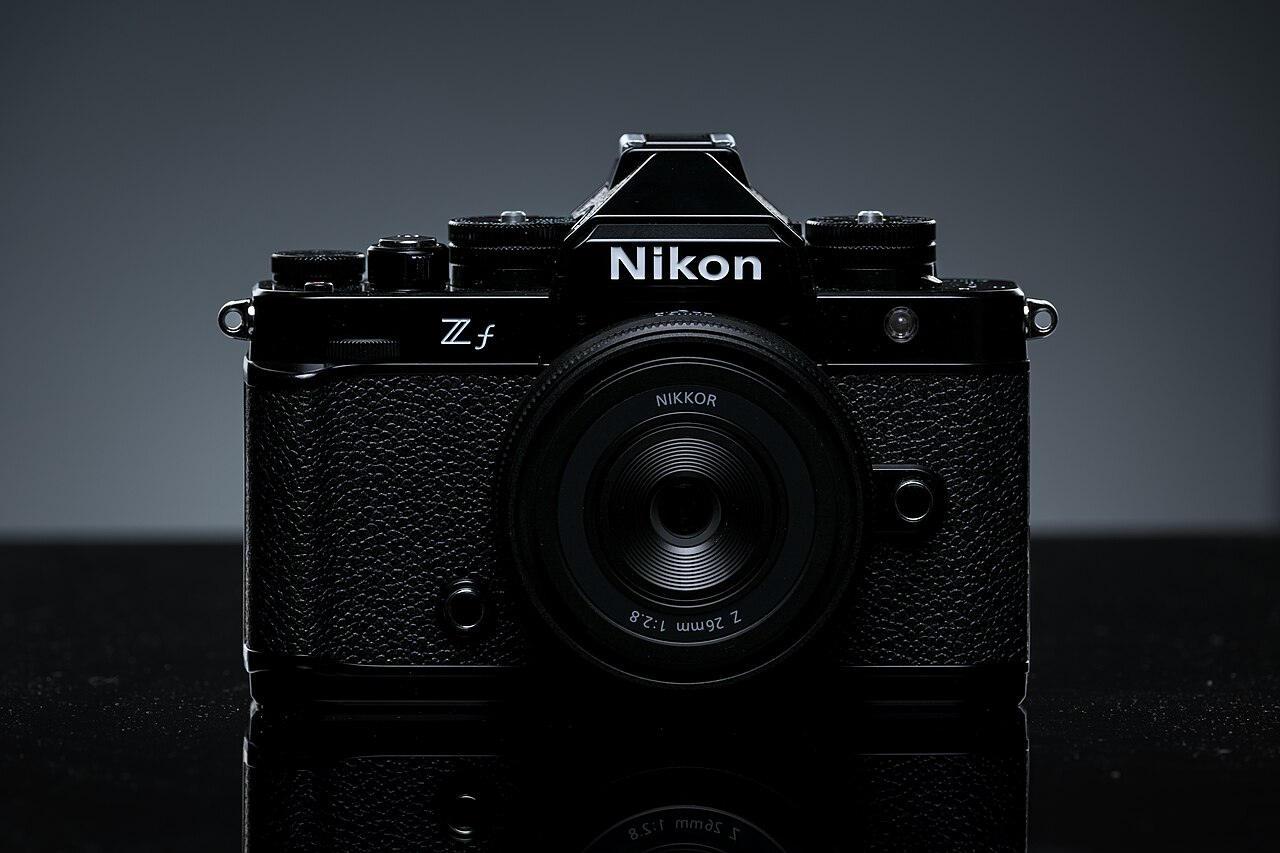
Nikon Z f (black body only; US model)
A good fit if: A shortlist option for a full-frame Z-mount lens plan and a screen that can face the person filming.
The tradeoff: The second card slot is microSD UHS-I, so do not assume two identical UHS-II SD slots.
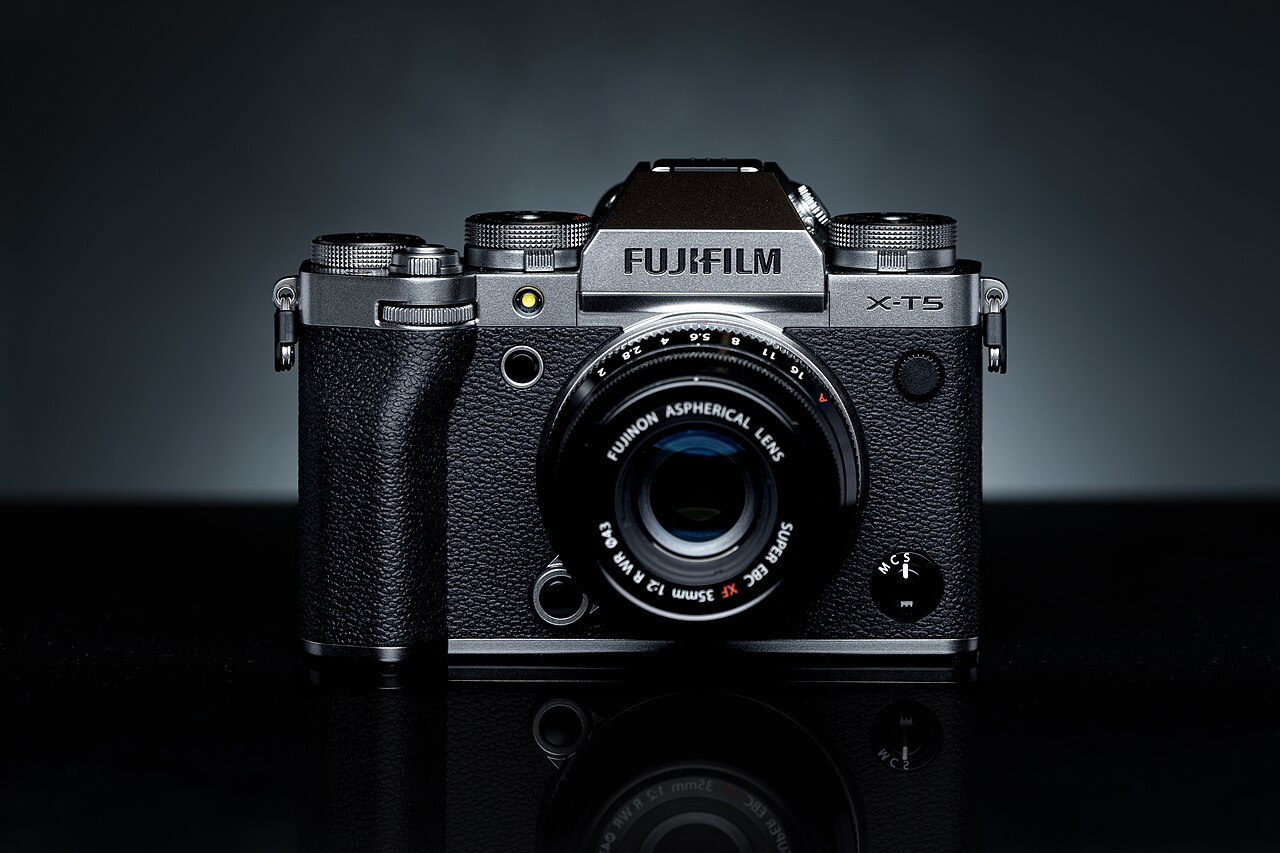
Fujifilm X-T5 (black body only)
A good fit if: A shortlist option for a high-resolution APS-C X-mount stills kit and two matching SD slots.
The tradeoff: The screen tilts rather than facing forward; more pixels do not guarantee better photographs or better low-light performance.
As an Amazon Associate I earn from qualifying purchases. How shopping links work.
Nikon Z f
View this model on Amazon : Nikon Z f (black body only; US model) (opens in a new tab)Body only; confirm selected black US-model package.Fujifilm X-T5
View this model on Amazon : Fujifilm X-T5 (black body only) (opens in a new tab)Check the seller, exact variant, price and included accessories.See the product photos and comparison illustration
The facts, side by side.
Manufacturer specifications for the named models. On small screens, scroll the table sideways. A blank research field means the fact was not included here, not that the manufacturer does not publish it. Conditions and differently scoped specifications are kept separate.
| What matters | Nikon Z f [1] | Fujifilm X-T5 [2] |
|---|---|---|
| Effective resolution | 24.5 megapixels | 40.2 megapixels |
| Sensor format | FX full frame; Nikon Z mount | APS-C; Fujifilm X mount |
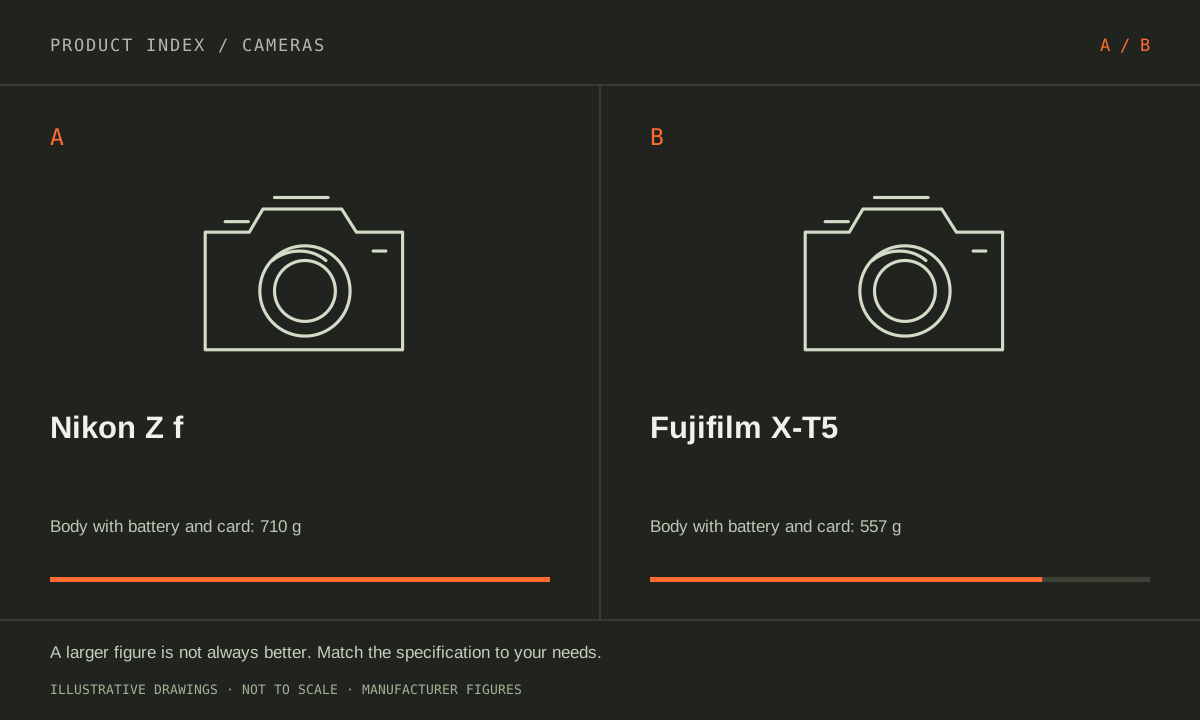
| Body with battery/card | Approximately 710 g | Approximately 557 g |
| Viewfinder and screen | Electronic viewfinder; 3.2-inch vari-angle screen | Electronic viewfinder; three-way tilting screen |
| Stabilization | Sensor-shift in-body stabilization; conditional up-to-8-stop claim | Sensor-shift in-body stabilization; up to 7 stops with specified lens |
| Memory card slots | One UHS-II SD plus one UHS-I microSD slot | Two UHS-II SD slots |
| Controls | Dedicated shutter-speed, ISO and exposure-compensation dials | Dedicated shutter-speed, ISO and exposure-compensation dials |
Listed maximums are manufacturer claims under their stated conditions, not results from our own testing. Regional versions and bundles can differ. No live prices or stock claims are shown.
Sensor format and resolution answer separate questions
A larger sensor format and a larger pixel count are not the same feature. Z f uses Nikon Z lenses with a full-frame imaging area; X-T5 uses Fujifilm X lenses for APS-C. Compare the actual lenses that provide the desired framing and working distance. An identical millimetre number gives different framing across the formats. A lens’s maximum aperture, focusing range, size and price all belong in the system decision, alongside the body.
X-T5’s higher pixel count can be useful when the output or crop plan needs more source pixels. It also creates a file-handling requirement that should be checked with the chosen raw workflow, storage and computer. Pixel count alone cannot rank dynamic range, noise, lens performance or autofocus. Likewise, a full-frame label cannot establish a better result for every subject. Decide whether the intended photographs require large prints, substantial cropping, fast delivery or a light travel kit, then evaluate relevant evidence.
Manufacturer references: Nikon Z f · Fujifilm X-T5
Screen movement and card formats change the working routine
Nikon supplies a 3.2-inch vari-angle screen that can face forward. X-T5 has a three-way tilting screen rather than a forward-facing self-recording arrangement. For stills at waist level or from a low position, a tilt screen may suit the task well. For a solo spoken recording, a screen visible from in front creates a different benefit. Check cable, microphone and support clearance instead of assuming all movable screens function identically in a rig.
Z f combines one UHS-II SD slot with a UHS-I microSD slot. X-T5 has two UHS-II SD slots. Those are materially different card packages. Read supported recording and backup modes, select the required card speeds and plan readers and spares for the actual formats. A second card slot does not itself provide a complete backup process; copies after shooting and failure handling still matter. Do not describe Nikon’s two slots as two identical full-size UHS-II SD connections.
Manufacturer references: Nikon Z f · Fujifilm X-T5
Dials, stabilization and weight still need context
Dedicated shutter-speed, ISO and exposure-compensation dials can suit a deliberate manual-control routine, but photographs of dials cannot establish grip comfort or how quickly someone can operate them with the intended lens. Try the handling and grip with real shooting settings where possible. Nikon lists approximately 710 g with battery and card; Fujifilm lists about 557 g on that basis. Add the selected lenses and accessories before deciding which complete system is easier to carry.
Both publish stabilization claims under specified CIPA conditions, using different test arrangements. Nikon’s up-to-eight-stop figure and Fujifilm’s up-to-seven-stop figure are not a shared one-stop comparison, and neither freezes subject movement. Video modes also have their own format and crop conditions; check the exact deliverable rather than merging every maximum. Favor Nikon when its full-frame lens plan, facing screen and card arrangement fit. Favor X-T5 when its APS-C lenses, higher source-pixel count and matching SD slots suit the work.
Manufacturer references: Nikon Z f · Fujifilm X-T5
A CLOSER LOOK AT OWNERSHIP
Beyond the specification sheet.
Additional model-specific document research checked October 20, 2026. The original comparison’s specification check date remains shown above.
Check the complete setup before ordering
Nikon Z f uses SD and microSD slots with different interface specifications in Nikon’s manual. Choose your storage arrangement deliberately and rehearse the intended duplicate or overflow workflow. Evaluate the body with the actual Z-mount or approved adapted lens; styling alone does not tell you how a heavy lens handles.
For X-T5, choose the recording mode and intended card-slot behavior before selecting cards. Fujifilm documents two UHS-II SD slots and mode-dependent file formats. Try the screen from the actual shooting position, and import representative files into your editor so resolution is considered alongside storage and processing requirements.
Sources: Nikon Z f — manufacturer model information; no independent performance test (opens in a new tab) · Nikon Z f manual — SD/microSD slot and lens specifications (opens in a new tab) · Fujifilm X-T5 — manufacturer model information; no independent performance test (opens in a new tab) · Fujifilm X-T5 manual — card interfaces and recording specifications (opens in a new tab)
Price the equipment you will actually use
Price Z f with appropriate cards for both slots, the desired lens, and any grip or carrying accessory you actually need after handling it. Include the adapter only after verifying lens restrictions. Compare the full-frame working kit against the alternative, rather than equating similar retro controls with identical system costs.
An X-T5 quote should include the X-mount lenses needed for your subject, suitable cards, spare power, and any required audio adapter. Compare like-for-like lens coverage with the Nikon alternative. Higher-resolution capture may motivate a different file-management budget, but calculate it from your own sample files rather than assuming a universal multiplier.
Sources: Nikon Z f — manufacturer model information; no independent performance test (opens in a new tab) · Nikon Z f manual — SD/microSD slot and lens specifications (opens in a new tab) · Fujifilm X-T5 — manufacturer model information; no independent performance test (opens in a new tab) · Fujifilm X-T5 manual — card interfaces and recording specifications (opens in a new tab)
Plan care, parts, and the service route
Keep Z f firmware and service information specific to the exact body. Ask Nikon about regional coverage and the appropriate care procedure, particularly when buying imported equipment. Test both card types and record your settings during acceptance. The specification page supports the slot distinction but does not guarantee every third-party card combination.
Ask Fujifilm about X-T5 care, firmware, and local service before buying an unfamiliar seller’s kit. Inspect both card slots and the supplied charging accessories. Separate cosmetic wear from operational faults during a permitted used-equipment trial; neither a shutter-count claim nor a weather-resistance description establishes all remaining risks.
Sources: Nikon Z f — manufacturer model information; no independent performance test (opens in a new tab) · Nikon Z f manual — SD/microSD slot and lens specifications (opens in a new tab) · Fujifilm X-T5 — manufacturer model information; no independent performance test (opens in a new tab) · Fujifilm X-T5 manual — card interfaces and recording specifications (opens in a new tab)
What rules each option out—and when to keep what you own
Retro controls conceal different system requirements. Zf combines SD and microSD slots, while X-T5 documents two SD slots with its own interface specifications. Rule out a proposed workflow if its media or backup assumptions are wrong. Then compare lenses for equivalent intended framing; the Nikon full-frame and Fujifilm APS-C systems should not be judged by body appearance alone.
Keep existing equipment when the appeal is mainly a new control style that you have not tried. Test the grip with the actual lens and adjust settings while shooting. For a switch, count cards, lenses, batteries, carrying weight, and editing storage. A camera you enjoy carrying has value, but enjoyment and a measurable technical requirement are different purchase reasons.
Sources: Nikon Z f — manufacturer model information; no independent performance test (opens in a new tab) · Nikon Z f manual — SD/microSD slot and lens specifications (opens in a new tab) · Fujifilm X-T5 — manufacturer model information; no independent performance test (opens in a new tab) · Fujifilm X-T5 manual — card interfaces and recording specifications (opens in a new tab)
THE REST OF THE BUYING DECISION
Think beyond the upgrade.
A camera purchase includes a lens system, a way to capture sound, a storage workflow, and equipment you must be willing to carry. Begin with the shots your current kit cannot reliably deliver. This guide uses official Canon documentation for concrete examples while keeping the decision process applicable across brands. Specifications do not substitute for our own image-quality, autofocus, or endurance testing, which we do not claim here.
The cameras field guide covers the broader ownership questions, with source-specific examples. It complements this exact-model comparison; its examples do not establish features or policies for every model here.
MAKE IT YOUR DECISION
Your before-you-buy checklist.
Use this as a final check, alongside the model-specific evidence above.
Check off the questions you have resolved. Nothing is sent to a server.
Before you place the order.
- Match the full model name and generation. A similarly named bundle may have different accessories.
- Confirm the total price, seller, warranty eligibility, delivery estimate, and return terms at checkout.
- Account for any accessories or compatible equipment your setup needs. An upgrade only has value if you will use it.
Your product questions, answered.
Does Nikon Z f have two identical SD slots?
No. It has one UHS-II SD slot and one UHS-I microSD slot.
Can X-T5’s screen face the person in front of the lens?
It is a three-way tilting screen, not a forward-facing vari-angle screen. Check the required filming position before buying.
Are the two-slot arrangements identical?
No. Nikon Zf uses SD and microSD, while Fujifilm X-T5 uses two SD slots. Confirm supported recording roles and card requirements rather than assuming two slots describe the same workflow.
Sources: Nikon Z f — manufacturer model information; no independent performance test (opens in a new tab) · Nikon Z f manual — SD/microSD slot and lens specifications (opens in a new tab) · Fujifilm X-T5 — manufacturer model information; no independent performance test (opens in a new tab) · Fujifilm X-T5 manual — card interfaces and recording specifications (opens in a new tab)
Can I compare lenses by focal-length number alone?
Not for matching framing across these sensor formats. Choose the intended field of view and working distance, then compare the complete lenses suitable for each system.
Sources: Nikon Z f — manufacturer model information; no independent performance test (opens in a new tab) · Nikon Z f manual — SD/microSD slot and lens specifications (opens in a new tab) · Fujifilm X-T5 — manufacturer model information; no independent performance test (opens in a new tab) · Fujifilm X-T5 manual — card interfaces and recording specifications (opens in a new tab)
What should I test about the controls?
Try exposure changes, focus selection, and holding the camera with the lens you plan to use. A body-only demonstration may not represent the balance of the actual kit.
Sources: Nikon Z f — manufacturer model information; no independent performance test (opens in a new tab) · Nikon Z f manual — SD/microSD slot and lens specifications (opens in a new tab) · Fujifilm X-T5 — manufacturer model information; no independent performance test (opens in a new tab) · Fujifilm X-T5 manual — card interfaces and recording specifications (opens in a new tab)
Does the newer-looking specification justify switching?
Only if it resolves a specific limitation that matters to your work. Include the cost and handling of replacement lenses and storage, and preserve a functioning system when the benefit is unclear.
Sources: Nikon Z f — manufacturer model information; no independent performance test (opens in a new tab) · Nikon Z f manual — SD/microSD slot and lens specifications (opens in a new tab) · Fujifilm X-T5 — manufacturer model information; no independent performance test (opens in a new tab) · Fujifilm X-T5 manual — card interfaces and recording specifications (opens in a new tab)
Sources & limitations.
Original comparison research: October 18, 2026. Individual product-source checks and ownership additions carry their own dates. These links identify the manufacturer evidence used for the specifications. Recommendations and practical implications are our editorial judgments. We have not measured performance, reliability, comfort, or long-term ownership for this comparison.
- Nikon Z f (black body only; US model) — manufacturer specifications (opens in a new tab)
Nikon Z f announcement and video-mode conditions (opens in a new tab)
Checked October 18, 2026. - Fujifilm X-T5 (black body only) — manufacturer specifications (opens in a new tab)
Checked October 18, 2026.
Confirm current specifications for your region and exact bundle. Read our research and correction approach.