
THE DIFFERENCES THAT MATTER
EcoFlow DELTA 3 Plus vs APC SMT1500C: power station or computer UPS?
Distinguish outage energy from computer continuity, shutdown management and outlet-level planning.
Researched from manufacturer sources. These products have not been hands-on tested for this article.
START HERE
Are you trying to keep a computer session alive through a brief interruption or run equipment longer away from a socket?
EcoFlow DELTA 3 Plus and APC Smart-UPS SMT1500C contain batteries but are designed around different jobs. EcoFlow is a portable station with a 1,024 Wh nominal reserve and 1,800 W continuous AC output. APC is a line-interactive desk UPS with voltage regulation, monitoring connections and a 1,000 W real-power rating. A large battery number alone cannot establish that a product is the correct computer-protection device.
EcoFlow DELTA 3 Plus (US)
A good fit if: A shortlist option for buyers who can use the two solar inputs or higher-power USB-C connections.
The tradeoff: Its higher input limits do not add stored energy to the base station, and compatible panels and cables add cost and bulk.
APC Smart-UPS SMT1500C (120 V tower)
A good fit if: A shortlist option for a desk or small equipment rack where brief interruptions and orderly shutdown are the central problem.
The tradeoff: Its 1,000 W output is not a 1,500 W rating, and runtime must be read from the load-specific chart.
As an Amazon Associate I earn from qualifying purchases. How shopping links work.
DELTA 3 Plus
View this model on Amazon : EcoFlow DELTA 3 Plus (US) (opens in a new tab)Check the seller, exact variant, price and included accessories.APC SMT1500C
View this model on Amazon : APC Smart-UPS SMT1500C (120 V tower) (opens in a new tab)Check the seller, exact variant, price and included accessories.See the product photos and comparison illustration
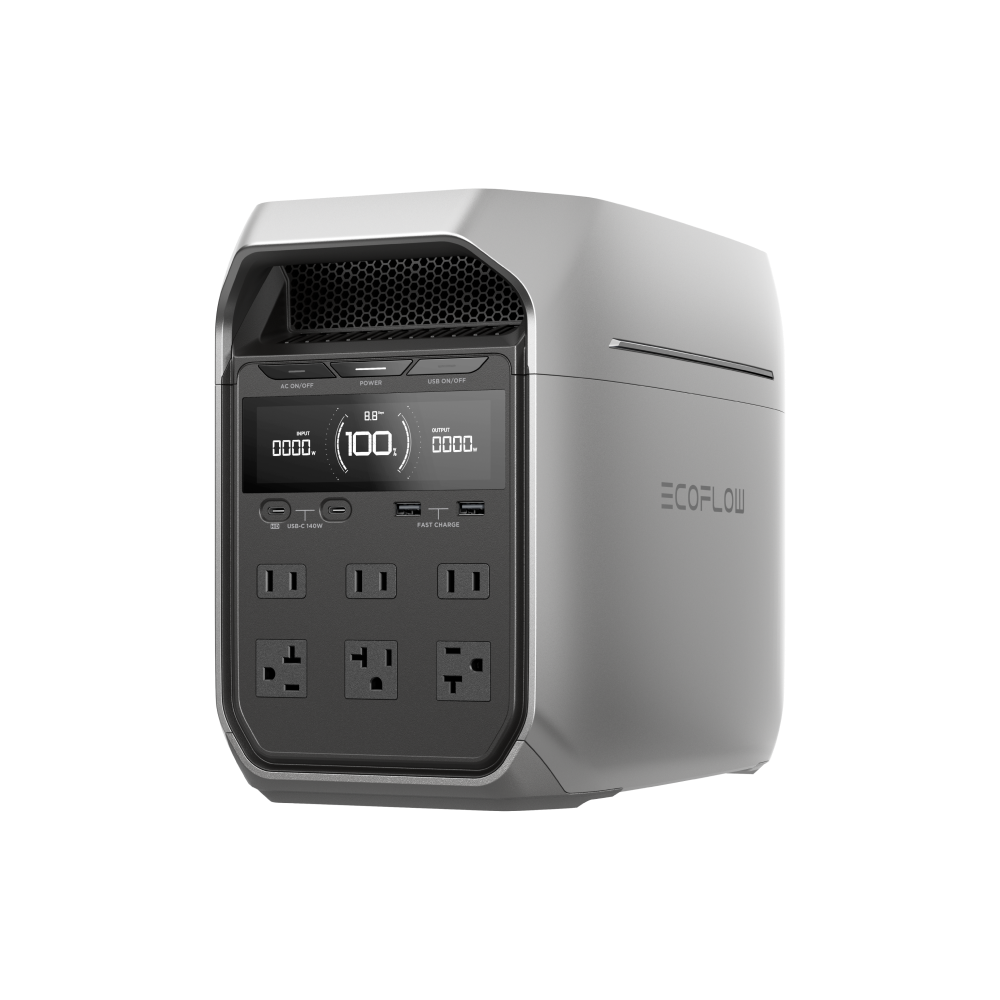
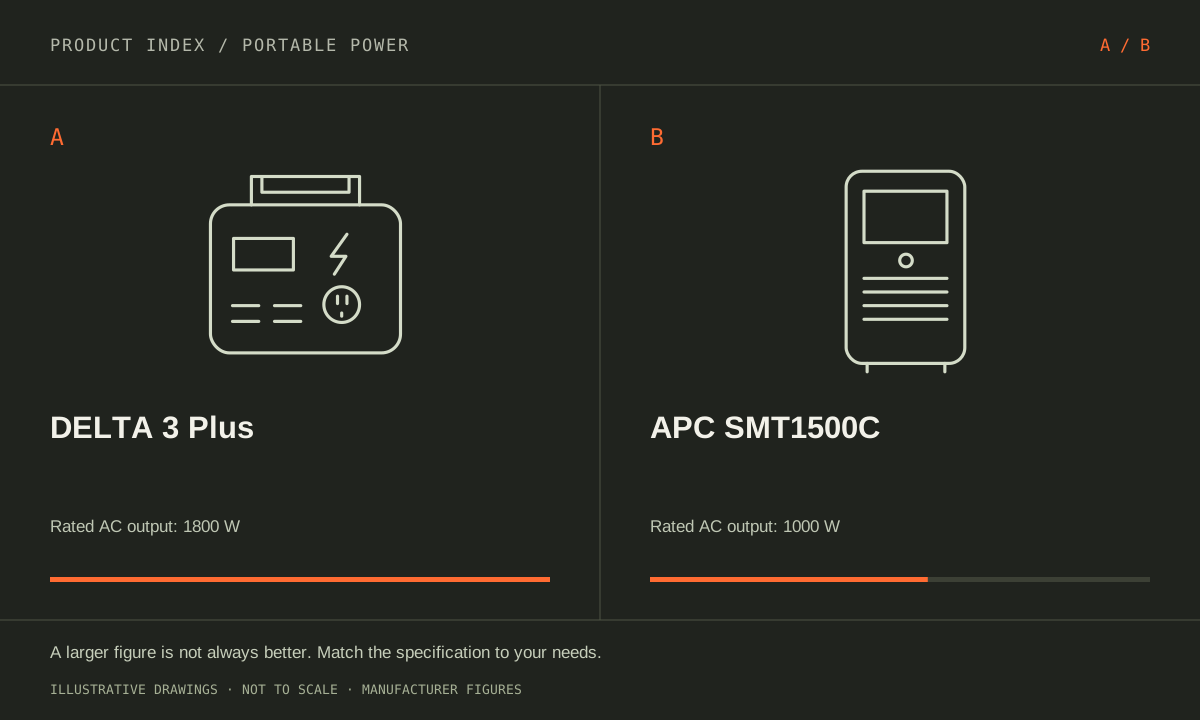
The facts, side by side.
Manufacturer specifications for the named models. On small screens, scroll the table sideways. A blank research field means the fact was not included here, not that the manufacturer does not publish it. Conditions and differently scoped specifications are kept separate.
| What matters | DELTA 3 Plus [1] | APC SMT1500C [2] |
|---|---|---|
| Battery capacity | 1,024 Wh nominal | Not included in this comparison |
| Rated AC output | 1,800 W total (US) | 1,000 W |
| Weight | Approximately 27.6 lb / 12.5 kg | Not included in this comparison |
| Dimensions | 398 × 202 × 283.6 mm | Not included in this comparison |
| Battery chemistry | LFP | Not included in this comparison |
| USB-C output | 2 ports; manufacturer lists 140 W maximum | Not included in this comparison |
| Solar input maximum | 1,000 W total; 2 × 500 W inputs | Not included in this comparison |
| Equipment type | Not included in this comparison | Line-interactive sine-wave UPS with AVR |
| Apparent-power rating | Not included in this comparison | 1,440 VA in current US specification; 1500 VA product family |
| AC connections | Not included in this comparison | 120 V; 8 × NEMA 5-15R outlets |
| Monitoring | Not included in this comparison | SmartConnect Ethernet port and SmartSlot |
| Battery | Not included in this comparison | Replaceable lead-acid battery |
Listed maximums are manufacturer claims under their stated conditions, not results from our own testing. Regional versions and bundles can differ. No live prices or stock claims are shown.
Define what must happen when mains power disappears
For a desktop, the first requirement may be to preserve a session long enough to save work and shut down. Include the display and any network equipment needed to finish that process. The APC is purpose-built as a line-interactive UPS, with automatic voltage regulation and monitoring options. Review its compatibility, communication features and load-specific runtime chart for the operating system and computer you actually own. Do not mistake the 1500 family name for 1,500 W.
EcoFlow’s portable energy reserve makes a different proposition: operating devices during an outage or at a location with no mains socket. Even when a power station advertises a fast backup transition, suitability depends on the connected equipment’s tolerance and the supported operating mode. A manufacturer’s transfer specification is not a universal guarantee that every workstation, storage device or medical device will remain uninterrupted. Establish continuity requirements first, then evaluate energy for the desired duration.
Manufacturer references: DELTA 3 Plus · APC SMT1500C
Read UPS runtime at the actual load
APC’s current US specification lists 1,440 VA and 1,000 W for SMT1500C. VA and watts describe different electrical quantities; both limits matter when selecting loads. A computer’s power-supply label is not its ordinary wall consumption. Measure the complete desk during the heaviest normal task, then consult the matching manufacturer runtime curve. Keep enough time for shutdown rather than designing around a battery being completely exhausted.
DELTA 3 Plus lists 1,024 Wh nominal battery capacity, but multiplying or dividing that number produces only a theoretical energy budget. Inverter consumption, conversion losses and selected reserve settings affect operation. A short shutdown window and a full afternoon of work are different purchase requirements. If both are essential, investigate the complete supported arrangement and communications behavior rather than assuming the larger nominal reserve also provides the same management features as a UPS.
Manufacturer references: DELTA 3 Plus · APC SMT1500C
Connect the right outlets and plan maintenance
SMT1500C provides eight NEMA 5-15R outlets, SmartConnect Ethernet and a SmartSlot. Inventory the equipment assigned to backup and check the manual’s connection instructions. Network monitoring is distinct from making the internet provider’s upstream equipment survive an outage. A powered home router cannot keep an unavailable outside service working. Likewise, supplying the desktop but forgetting its display or an external drive can defeat the intended graceful shutdown.
APC uses a replaceable lead-acid battery; EcoFlow uses LFP chemistry in a portable station. Chemistry alone does not rank the products for this job. Consider maintenance access, the supported replacement process, ventilation, monitoring and the weight or mobility the installation requires. Favor APC for a specified desk continuity and shutdown plan. Favor EcoFlow for a documented portable-energy requirement, with backup-mode compatibility checked separately. Buying either without identifying the failure you are solving leaves the most important question unanswered.
Manufacturer references: DELTA 3 Plus · APC SMT1500C
A CLOSER LOOK AT OWNERSHIP
Beyond the specification sheet.
Additional model-specific document research checked October 20, 2026. The original comparison’s specification check date remains shown above.
Check the complete setup before ordering
Treat the DELTA 3 Plus charging inputs as a system-design choice. Ask EcoFlow to approve the exact panel arrangement, cable, and input limits you intend to use. Confirm laptop charging profiles separately. More charging capability is useful only if the equipment and your available recharge time can use it.
APC SMT1500C is a UPS decision: connect the computer or network equipment and plan how it shuts down during an extended outage. Schneider documents PowerChute Serial Shutdown via supported wired connections. Verify the operating system and intended shutdown path; cloud status monitoring alone is not evidence that your computer will shut down safely.
Sources: DELTA 3 Plus — manufacturer model information; no independent performance test (opens in a new tab) · EcoFlow US warranty — eligibility and service scope, not universal damage coverage (opens in a new tab) · APC SMT1500C — manufacturer model information; no independent performance test (opens in a new tab) · Schneider Electric US SMT1500C listing — RBC7 replacement battery (opens in a new tab)
Price the equipment you will actually use
EcoFlow lists DELTA 3, DELTA 2, DELTA 2 Max, and DELTA Pro 3 Extra Batteries for DELTA 3 Plus, with an Alternator Charger XT150 Output Cable specified on the checked US page. These are extra-battery accessories, not second standalone stations. Include the named cable and selected battery in the complete expansion price.
Schneider lists the RBC7 replacement battery for SMT1500C. That provides a specific maintenance purchase to price before replacing the entire UPS when battery capacity declines. Include the supported computer communication cable and shutdown setup separately; a replacement cartridge and a cloud-monitoring subscription solve different ownership needs.
Sources: DELTA 3 Plus — manufacturer model information; no independent performance test (opens in a new tab) · EcoFlow US warranty — eligibility and service scope, not universal damage coverage (opens in a new tab) · APC SMT1500C — manufacturer model information; no independent performance test (opens in a new tab) · Schneider Electric US SMT1500C listing — RBC7 replacement battery (opens in a new tab)
Plan care, parts, and the service route
Save the DELTA 3 Plus manual and current US warranty alongside the serial number. Ask support about storage, firmware, battery service, and freight before relying on it for regular backup. The warranty policy describes eligibility and exclusions; it does not establish your eventual repair turnaround or guarantee unchanged battery capacity.
Ask the seller for the battery date and condition if considering old stock or a refurbished SMT1500C. Follow Schneider’s cartridge replacement and disposal instructions. Separate battery coverage, electronics coverage, and any SmartConnect service terms; none should be inferred from the headline UPS model number.
Sources: DELTA 3 Plus — manufacturer model information; no independent performance test (opens in a new tab) · EcoFlow US warranty — eligibility and service scope, not universal damage coverage (opens in a new tab) · APC SMT1500C — manufacturer model information; no independent performance test (opens in a new tab) · Schneider Electric US SMT1500C listing — RBC7 replacement battery (opens in a new tab)
What rules each option out—and when to keep what you own
This pair separates portable stored energy from an equipment-protection and shutdown workflow. Rule out a proposed setup if the connected computer cannot tolerate its interruption behavior or cannot perform the required shutdown. APC documents a shutdown-software path; verify the operating system and connection. Do not choose from Wh, VA, or maximum output alone, because those describe different requirements.
Keep a functioning UPS if it supplies the required short outage window and orderly shutdown; ask about an approved battery replacement before discarding it. Choose a portable station when its mobility and energy reserve solve a different job. For extended outages, a correctly designed combination may be worth expert review, but compatibility between the two is not established here.
Sources: DELTA 3 Plus — manufacturer model information; no independent performance test (opens in a new tab) · EcoFlow US warranty — eligibility and service scope, not universal damage coverage (opens in a new tab) · APC SMT1500C — manufacturer model information; no independent performance test (opens in a new tab) · Schneider Electric US SMT1500C listing — RBC7 replacement battery (opens in a new tab)
THE REST OF THE BUYING DECISION
Think beyond the upgrade.
The best portable power station is the one that powers your essential equipment for the time you need, can be recharged where you use it, and is manageable to carry. Start with an equipment list, not a promotional wattage. This guide explains the decisions behind a useful shortlist; manufacturer specifications are evidence of stated capabilities, not our own runtime tests.
The portable power field guide covers the broader ownership questions, with source-specific examples. It complements this exact-model comparison; its examples do not establish features or policies for every model here.
MAKE IT YOUR DECISION
Your before-you-buy checklist.
Use this as a final check, alongside the model-specific evidence above.
Check off the questions you have resolved. Nothing is sent to a server.
Before you place the order.
- Match the full model name and generation. A similarly named bundle may have different accessories.
- Confirm the total price, seller, warranty eligibility, delivery estimate, and return terms at checkout.
- Account for any accessories or compatible equipment your setup needs. An upgrade only has value if you will use it.
Your product questions, answered.
Is SMT1500C rated for a 1,500 W computer?
No. Its current US real-power rating is 1,000 W; the product-family VA label is not a watt rating.
Does a fast station transfer guarantee no computer reboot?
No. Check the precise backup mode and connected equipment requirements. Transfer behavior is not a universal compatibility guarantee.
Are SmartConnect and shutdown software the same thing?
No. Schneider distinguishes remote monitoring from PowerChute Serial Shutdown using supported wired connections. Verify the exact shutdown route needed by your computer rather than assuming monitoring performs it.
Sources: DELTA 3 Plus — manufacturer model information; no independent performance test (opens in a new tab) · EcoFlow US warranty — eligibility and service scope, not universal damage coverage (opens in a new tab) · APC SMT1500C — manufacturer model information; no independent performance test (opens in a new tab) · Schneider Electric US SMT1500C listing — RBC7 replacement battery (opens in a new tab)
Does 1500VA mean 1500 watts?
No. Use the SMT1500C real-power specification and load-specific runtime chart. The VA family name alone does not establish either supported watts or how long your equipment will run.
Sources: DELTA 3 Plus — manufacturer model information; no independent performance test (opens in a new tab) · EcoFlow US warranty — eligibility and service scope, not universal damage coverage (opens in a new tab) · APC SMT1500C — manufacturer model information; no independent performance test (opens in a new tab) · Schneider Electric US SMT1500C listing — RBC7 replacement battery (opens in a new tab)
Which replacement battery does SMT1500C use?
Schneider lists RBC7 for this US model. Price the complete approved cartridge and follow its replacement instructions; do not substitute a battery merely because its voltage label looks similar.
Sources: DELTA 3 Plus — manufacturer model information; no independent performance test (opens in a new tab) · EcoFlow US warranty — eligibility and service scope, not universal damage coverage (opens in a new tab) · APC SMT1500C — manufacturer model information; no independent performance test (opens in a new tab) · Schneider Electric US SMT1500C listing — RBC7 replacement battery (opens in a new tab)
Can I simply connect one to the other?
No such combined setup is validated in this comparison. Obtain manufacturer guidance for the exact load, charging behavior, grounding arrangement, and operating mode before planning a chained system.
Sources: DELTA 3 Plus — manufacturer model information; no independent performance test (opens in a new tab) · EcoFlow US warranty — eligibility and service scope, not universal damage coverage (opens in a new tab) · APC SMT1500C — manufacturer model information; no independent performance test (opens in a new tab) · Schneider Electric US SMT1500C listing — RBC7 replacement battery (opens in a new tab)
Sources & limitations.
Original comparison research: October 18, 2026. Individual product-source checks and ownership additions carry their own dates. These links identify the manufacturer evidence used for the specifications. Recommendations and practical implications are our editorial judgments. We have not measured performance, reliability, comfort, or long-term ownership for this comparison.
- EcoFlow DELTA 3 Plus (US) — manufacturer specifications (opens in a new tab)
Checked October 18, 2026. - APC Smart-UPS SMT1500C (120 V tower) — manufacturer specifications (opens in a new tab)
Checked October 18, 2026.
Confirm current specifications for your region and exact bundle. Read our research and correction approach.