THE DIFFERENCES THAT MATTER
BLUETTI AC200L vs Anker SOLIX C2000 Gen 2: solar input or portability?
Two 2,048 Wh LFP stations with different solar ceilings, USB-C layouts and listed weights. Check the exact AC output path before buying.
Researched from manufacturer sources. These products have not been hands-on tested for this article.
START HERE
Will your kit use a larger solar input, or will a lighter station make the bigger difference?
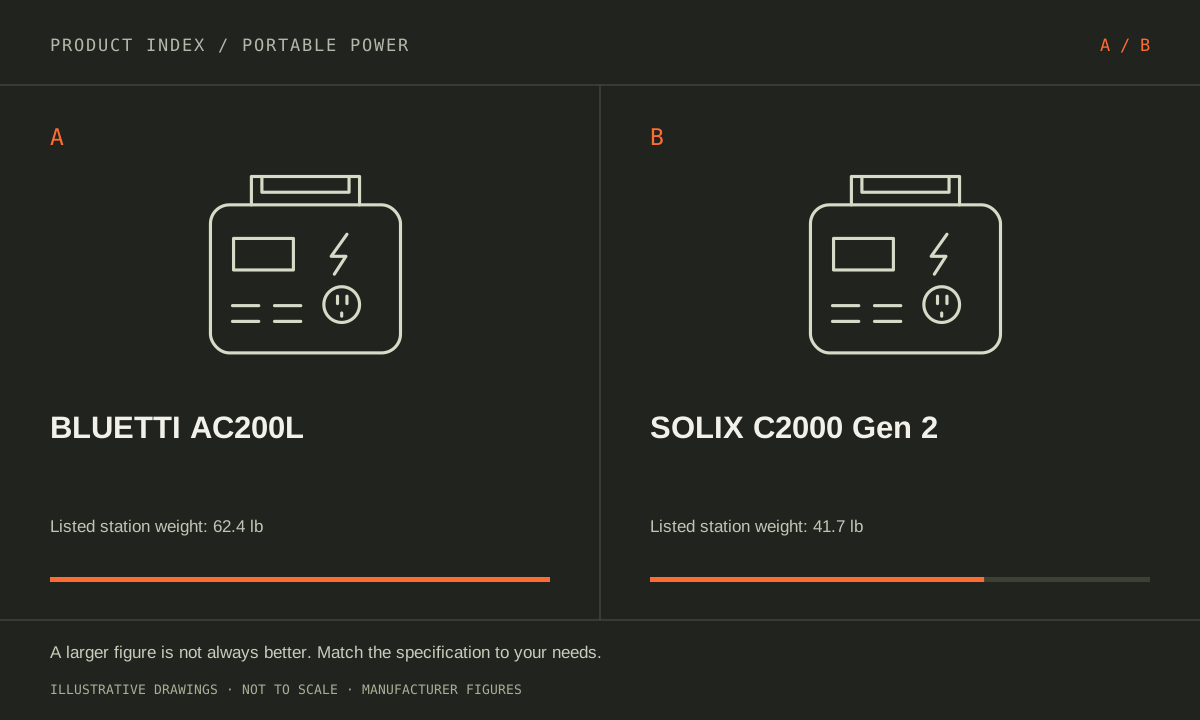
These US stations share 2,048 Wh nominal storage and a 2,400 W headline AC rating, but their listed weights are far apart: 62.4 lb for AC200L and 41.7 lb for C2000 Gen 2. BLUETTI publishes the larger solar-input ceiling. Anker offers higher maximum USB-C power on two ports. The useful comparison is the complete setup you will carry and recharge, with the exact output limits checked in the manual.
BLUETTI AC200L (US)
A good fit if: A shortlist option for a compatible solar array that can use more than an 800 W input ceiling.
The tradeoff: The 62.4 lb listed unit is substantially heavier than C2000 Gen 2; 3,600 W Power Lifting is a separate operating mode.
Anker SOLIX C2000 Gen 2 (US)
A good fit if: A shortlist option for regular carrying and compatible high-power USB-C devices when the 800 W solar ceiling fits.
The tradeoff: Check output-path limits: the detailed specification lists a different limit for the bidirectional inlet from the ordinary AC outlets.
As an Amazon Associate I earn from qualifying purchases. How shopping links work.
BLUETTI AC200L
View this model on Amazon : BLUETTI AC200L (US) (opens in a new tab)Check the seller, exact variant, price and included accessories.SOLIX C2000 Gen 2
View this model on Amazon : Anker SOLIX C2000 Gen 2 (US) (opens in a new tab)Check the seller, exact variant, price and included accessories.See the product photos and comparison illustration
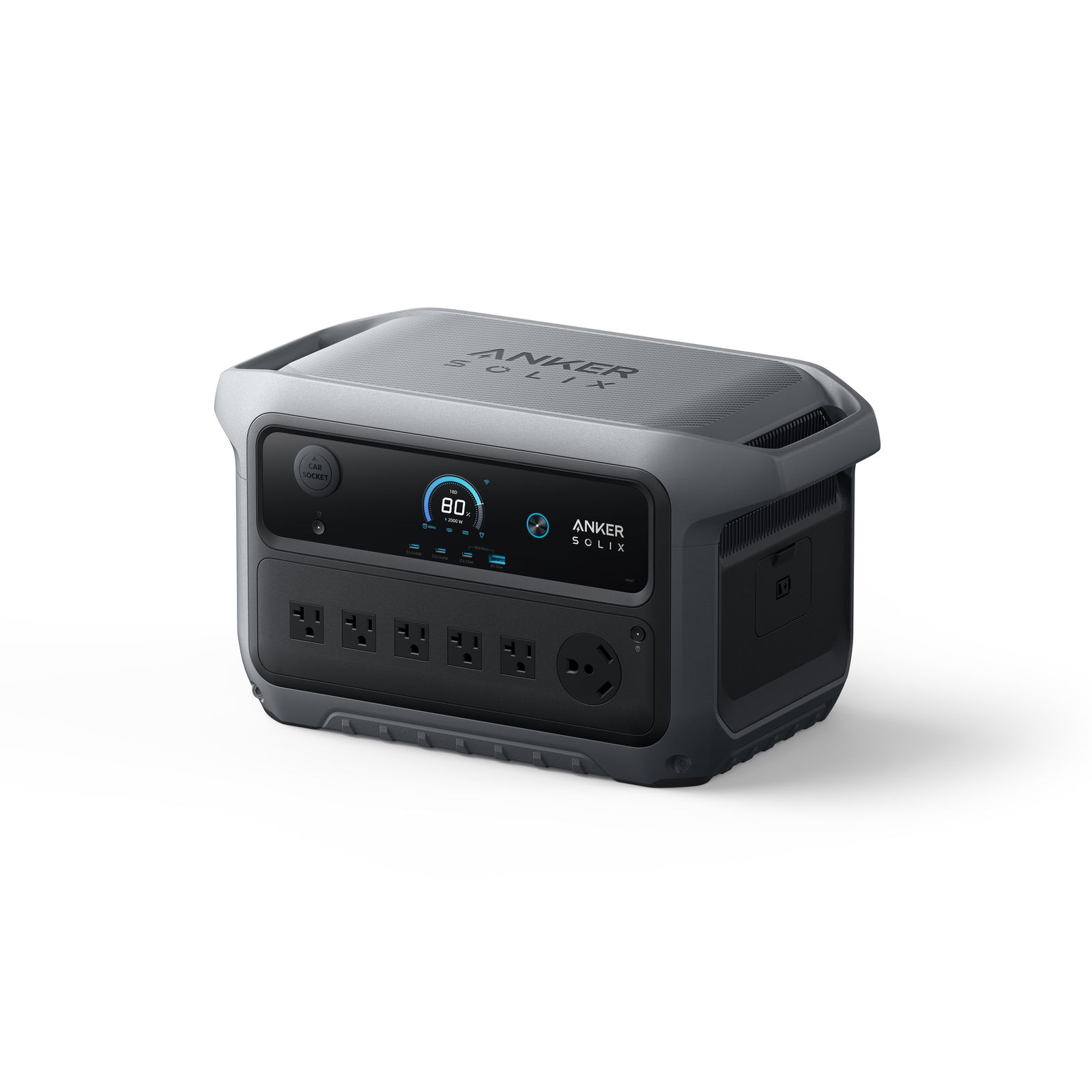
The facts, side by side.
Manufacturer specifications for the named models. On small screens, scroll the table sideways. A blank research field means the fact was not included here, not that the manufacturer does not publish it. Conditions and differently scoped specifications are kept separate.
| What matters | BLUETTI AC200L [1] | SOLIX C2000 Gen 2 [2] |
|---|---|---|
| Battery capacity | 2,048 Wh nominal | 2,048 Wh nominal |
| Rated AC output | 2,400 W total; US station | 2,400 W total; 1,800 W bidirectional inlet limit |
| Weight | 62.4 lb / 28.3 kg (detailed specifications) | 41.7 lb / 18.9 kg |
| Battery chemistry | LiFePO4 (LFP) | LFP |
| Solar input maximum | 1,200 W; compatible voltage/current required | 800 W; 11–60 V, 17 A maximum |
| USB-C output | 2 × up to 100 W | 2 × up to 140 W; 1 × 15 W |
Listed maximums are manufacturer claims under their stated conditions, not results from our own testing. Regional versions and bundles can differ. No live prices or stock claims are shown.
Do not turn equal watt-hours into a runtime verdict
Equal nominal capacity establishes a similar reserve class, without establishing equal energy delivered to an appliance. Inverter and idle consumption, temperature and operating mode still matter. Use the 2,400 W continuous class to screen the combined load, and keep BLUETTI’s Power Lifting and Anker’s peak claims separate. Neither is permission to ignore an appliance’s supply requirements or an individual port limit.
Anker’s page deserves particular care: its output infographic and detailed table use different figures for ordinary AC connections. The detailed table lists up to 2,400 W for NEMA and TT-30 outputs and 1,800 W for the bidirectional inlet. If your intended load is near a limit, confirm the precise connection in the current manual before purchase. This comparison does not resolve that documentation discrepancy by silently choosing the bigger figure.
Manufacturer references: BLUETTI AC200L · SOLIX C2000 Gen 2
More solar allowance helps only when the array can supply it
AC200L lists up to 1,200 W solar input; C2000 Gen 2 lists up to 800 W with its stated voltage and current limits. A compatible array capable of exceeding 800 W makes that difference worth investigating. One modest folding panel in partial shade will not gain output simply because the station accepts a higher maximum. Panel placement and the full electrical arrangement are part of the choice.
Inventory the panels, open-circuit voltage, operating current, connectors and cables before shopping for a bundle. Leave room for the deployment footprint, and account for how often you will actually set it up. Someone who recharges from a wall after a weekend may give this ceiling little weight. Someone trying to replenish essential energy daily from solar should assess input limits alongside weather and the amount of reserve needed between charging opportunities.
Manufacturer references: BLUETTI AC200L · SOLIX C2000 Gen 2
The carry route and USB-C plan can settle the shortlist
Anker’s published station weight is 20.7 lb lower. That is a meaningful handling difference for stairs, vehicle loading or moving between rooms, although it does not make 41.7 lb trivial. Compare the complete load, including panels and extra batteries, and measure the location where it will operate. Neither a smaller case nor a lower weight tells us which station will be more reliable over time.
AC200L lists two USB-C ports up to 100 W each; C2000 Gen 2 lists two up to 140 W plus a 15 W USB-C port. Compatible devices and cables are required to use those higher rates. Anker also shares a limit between its low-power USB-C and USB-A connections. Favor AC200L for a solar plan that uses its higher ceiling; favor C2000 Gen 2 when handling or high-power USB-C addresses a regular need.
Manufacturer references: BLUETTI AC200L · SOLIX C2000 Gen 2
A CLOSER LOOK AT OWNERSHIP
Beyond the specification sheet.
Additional model-specific document research checked October 20, 2026. The original comparison’s specification check date remains shown above.
Check the complete setup before ordering
AC200L has documented expansion-battery connections, with different allowed arrangements by battery model. Use BLUETTI’s exact compatibility guidance, including the cable, rather than a generic external-battery assumption. Ask support to confirm newer accessory revisions against the delivered station and firmware before purchasing a large expansion bundle.
Use the C2000 Gen 2 A1783 United States guide for setup. It documents charging and discharging limits plus output-memory settings in the app. Decide which behavior you want after a low battery or interruption, then verify the actual connected equipment recovers as intended before relying on unattended operation.
Sources: BLUETTI AC200L — manufacturer model information; no independent performance test (opens in a new tab) · AC200L manual — expansion connections; confirm current battery revisions with support (opens in a new tab) · SOLIX C2000 Gen 2 — manufacturer model information; no independent performance test (opens in a new tab) · C2000 Gen 2 A1783 United States guide — accessory purchasing and settings (opens in a new tab)
Price the equipment you will actually use
An AC200L purchase may require solar cabling or an expansion cable beyond the chosen package. Quote those items by part number and include the effort of deploying the panels. If the larger solar allowance is the attraction, verify that your proposed array is electrically suitable and fits the available space.
The C2000 Gen 2 US guide identifies solar connection cables and the car charging cable as separate purchases. List those explicitly if either charging method matters. A low station-only price does not describe the cost of the complete travel kit, and an included AC cable does not solve every recharge plan.
Sources: BLUETTI AC200L — manufacturer model information; no independent performance test (opens in a new tab) · AC200L manual — expansion connections; confirm current battery revisions with support (opens in a new tab) · SOLIX C2000 Gen 2 — manufacturer model information; no independent performance test (opens in a new tab) · C2000 Gen 2 A1783 United States guide — accessory purchasing and settings (opens in a new tab)
Plan care, parts, and the service route
Ask BLUETTI how AC200L storage, firmware support, battery faults, and heavy-item returns are handled in your region. The manual supports setup decisions but is not evidence of an individual warranty outcome. Save any written accessory approval and distinguish normal battery aging from a defect when requesting service guidance.
Keep the C2000 Gen 2 region and hardware identification with the receipt. Ask Anker about its prescribed storage routine, battery-service route, and current warranty exclusions. Record app limits and output settings before troubleshooting a shutdown. We have not established a battery-replacement price or guaranteed turnaround for this model.
Sources: BLUETTI AC200L — manufacturer model information; no independent performance test (opens in a new tab) · AC200L manual — expansion connections; confirm current battery revisions with support (opens in a new tab) · SOLIX C2000 Gen 2 — manufacturer model information; no independent performance test (opens in a new tab) · C2000 Gen 2 A1783 United States guide — accessory purchasing and settings (opens in a new tab)
What rules each option out—and when to keep what you own
Treat the larger-panel argument and easier-carrying argument as different requirements. Reject an AC200L solar plan if the array is unverified or impractical to deploy. Reject a C2000 Gen 2 setup if its exact US output path or restart behavior does not meet the connected equipment’s needs. Compare the actual system rather than a headline inverter tie.
If the present station already runs the equipment, improve the specific weak link first. A better cable route, different charging schedule, or supported expansion may cost less than changing platforms. If weight is the main problem, rehearse the station plus panels and accessories; a lighter battery does not make a large solar kit effortless.
Sources: BLUETTI AC200L — manufacturer model information; no independent performance test (opens in a new tab) · AC200L manual — expansion connections; confirm current battery revisions with support (opens in a new tab) · SOLIX C2000 Gen 2 — manufacturer model information; no independent performance test (opens in a new tab) · C2000 Gen 2 A1783 United States guide — accessory purchasing and settings (opens in a new tab)
THE REST OF THE BUYING DECISION
Think beyond the upgrade.
The best portable power station is the one that powers your essential equipment for the time you need, can be recharged where you use it, and is manageable to carry. Start with an equipment list, not a promotional wattage. This guide explains the decisions behind a useful shortlist; manufacturer specifications are evidence of stated capabilities, not our own runtime tests.
The portable power field guide covers the broader ownership questions, with source-specific examples. It complements this exact-model comparison; its examples do not establish features or policies for every model here.
MAKE IT YOUR DECISION
Your before-you-buy checklist.
Use this as a final check, alongside the model-specific evidence above.
Check off the questions you have resolved. Nothing is sent to a server.
Before you place the order.
- Match the full model name and generation. A similarly named bundle may have different accessories.
- Confirm the total price, seller, warranty eligibility, delivery estimate, and return terms at checkout.
- Account for any accessories or compatible equipment your setup needs. An upgrade only has value if you will use it.
Your product questions, answered.
Is the Anker model simply called C2000?
The exact product here is SOLIX C2000 Gen 2, the US 2,048 Wh model. Match the generation and region.
Does the 140 W USB-C port always charge at 140 W?
No. The device and cable must support the required USB Power Delivery profile; the port figure is a maximum capability.
What must be added to the Anker station-only price?
Its US guide identifies solar connection cabling and car charging cable as separate purchases. Add whichever your routine requires, plus approved panels, before comparing a bundled BLUETTI offer.
Sources: BLUETTI AC200L — manufacturer model information; no independent performance test (opens in a new tab) · AC200L manual — expansion connections; confirm current battery revisions with support (opens in a new tab) · SOLIX C2000 Gen 2 — manufacturer model information; no independent performance test (opens in a new tab) · C2000 Gen 2 A1783 United States guide — accessory purchasing and settings (opens in a new tab)
Does AC200L accept any external battery?
No generic external-battery compatibility is established. BLUETTI documents specific families and arrangements. Confirm the exact battery revision, quantity, and expansion cable with support before buying.
Sources: BLUETTI AC200L — manufacturer model information; no independent performance test (opens in a new tab) · AC200L manual — expansion connections; confirm current battery revisions with support (opens in a new tab) · SOLIX C2000 Gen 2 — manufacturer model information; no independent performance test (opens in a new tab) · C2000 Gen 2 A1783 United States guide — accessory purchasing and settings (opens in a new tab)
Why test output-memory settings?
The Anker guide describes configurable recovery behavior. Rehearse how your equipment restarts after low charge or interruption so a desired unattended routine is supported by the actual settings.
Sources: BLUETTI AC200L — manufacturer model information; no independent performance test (opens in a new tab) · AC200L manual — expansion connections; confirm current battery revisions with support (opens in a new tab) · SOLIX C2000 Gen 2 — manufacturer model information; no independent performance test (opens in a new tab) · C2000 Gen 2 A1783 United States guide — accessory purchasing and settings (opens in a new tab)
How should I compare service?
Request the applicable US policies, battery-service options, collection requirements, and current freight responsibilities. Neither a large capacity nor a long headline warranty establishes a particular repair outcome.
Sources: BLUETTI AC200L — manufacturer model information; no independent performance test (opens in a new tab) · AC200L manual — expansion connections; confirm current battery revisions with support (opens in a new tab) · SOLIX C2000 Gen 2 — manufacturer model information; no independent performance test (opens in a new tab) · C2000 Gen 2 A1783 United States guide — accessory purchasing and settings (opens in a new tab)
Sources & limitations.
Original comparison research: October 18, 2026. Individual product-source checks and ownership additions carry their own dates. These links identify the manufacturer evidence used for the specifications. Recommendations and practical implications are our editorial judgments. We have not measured performance, reliability, comfort, or long-term ownership for this comparison.
- BLUETTI AC200L (US) — manufacturer specifications (opens in a new tab)
The detailed product specifications list 62.4 lb / 28.3 kg, while the same page’s comparison widget lists 61.6 lb. This comparison uses the detailed specification and flags the discrepancy.
BLUETTI AC200L user manual (opens in a new tab)
Checked October 18, 2026. - Anker SOLIX C2000 Gen 2 (US) — manufacturer specifications (opens in a new tab)
The page infographic labels ordinary AC outlets at 1,800 W, while its detailed table lists NEMA 5-20R at 2,400 W maximum and the bidirectional inlet at 1,800 W. Confirm the exact output path and manual before a near-limit load.
Anker C2000 Gen 2 detailed output and input table (opens in a new tab)
Checked October 18, 2026.
Confirm current specifications for your region and exact bundle. Read our research and correction approach.